
“Same, Lindsay.”
You might have seen that hashtag or meme online this week. It was all over social media. A mother in her bathroom with a toddler on the floor next to her crying into a toilet. “Same, Lindsay.” A woman rather roughly bouncing her fussy six-month old baby. “Same, Lindsay.” Women taking buckets of ice and throwing them with fury into bathtubs. “Same, Lindsay.” A woman slamming a pillow against a closet door over and over again in a fit of rage. All with the same hashtag, “Same, Lindsay.”
The message, “I feel the exact same way you did, Lindsay Clancy, before you strangled your three children to death.” Look at me. Watch me. Validate me.
Cora was 5. Dawson was 3. And baby Callan was just 8 months old. They were all murdered by their mother, Lindsey, on January 24, 2023 at their home in Duxbury, Massachusetts. If you’re watching the news at all, you know that she is currently on trial some three and half years after these innocent children were murdered.
I confess I haven’t watched the trial itself, but I’ve kept up in the last few days with news and articles, and I’ve seen the viral videos on my feed all week. There is no factual dispute. Lindsay has confessed to the murders. The question for the jury is about criminal responsibility. Is she legally responsible for the killings or was she in a state of postpartum psychosis combined with a bipolar disorder and therefore not guilty by reason of insanity? Today was day 18 of the trial and the defense is near the end of its case. Closing arguments are expected early next week.
I’m not here to decide the case. I’m not in the courtroom. I have faith in our justice system and in our fellow citizens serving on the jury. A difficult job to be sure. They alone will make the final decision after having seen all the evidence and having sat through the expert testimonies and cross-examinations. Her fate will soon be their hands. Life in prison or in a mental hospital. Either way, this was a tragedy.
Let me say clearly that it is important for mothers to be able to express their anger, their depression, their anxiety, and their fears. There has been silence for too long. No one should be shamed for seeking help, opening up to a friend or therapist, or struggling with postpartum depression. This tragedy sheds light on the inability of our medical system to help millions of women in their darkest hours. I have been a mother of three young children. I have been sleep deprived for weeks, months, physically exhausted and emotionally drained. There were moments of frustration when I needed to breathe, get out of the house, take a walk, or ask for help. All of these feelings should be normalized and discussed openly. But that healthy approach, that thoughtful reconsideration of telehealth and the broken psychiatric establishment, is not what is happening in the viral videos.
The problem isn’t telling the truth about the darkness.
The problem is when darkness becomes the content.
When did we become comfortable watching things like children crying unconsoled near their mothers that we were once unable to watch? I confess, I have to quickly scroll through a clip that is going viral of a malign young woman splashing a tiny baby’s face with water from her cup over and over again. I feel physically ill. These mothers are the main characters in their own twisted movies. And this is what social media algorithms give us. This is what some portions of our society are consuming.
This week in Parshat Ki Teitze we read about the famous commandment to spare the mother bird when taking her young, “If a bird’s nest happens to be before you…the mother sitting upon the young… you shall not take the mother together with her young. You shall surely send away the mother.”
Our Torah is trying to create a boundary around suffering. Yes, baby chicks will be taken, but the mother bird should not be forced to witness the end of her chicks. It is incredible that our tradition is so beautifully sensitive to the feelings of a bird. It is this same impulse which caused scripture to forbid cooking a calf in its own mother’s milk. The calf wouldn’t know. Would the mother even know? It doesn’t matter. God’s creations might or might not have emotional awareness — but we do. Such callous acts against animals are a perversion of life itself. They are darkness. The Torah and our Sages say, “Don’t make the mother watch.” But the algorithm shrieks, “Make everybody watch.”
The rabbis, men of infinite wisdom who lived long before psychologists, knew that being exposed to animal cruelty can have a profound effect. They knew that what we see can become who we are. The spiritual danger we face today is not that darkness exists, Jews know it exists. We have lived it, survived it, fought against it in every generation, it’s that we are getting accustomed to it, inured to it. Our eyes are adjusting.
We scroll through our medium of choice and see recipes, vacation photos, a mother in crisis, a shoe advertisement, news on a local stabbing, a funny cat video, another mother’s breakdown. Everything becomes a blur. An hour goes by. Everything melds into a single stream. And everything is eventually compressed down into a bleak moral equivalence.
I think about Dorothy and friends in the poppy fields in Oz, lazing around, forgetting their purpose, forgetting the yellow brick road and getting to the Emerald City. Or the lotus eaters of Greek myth, numbing themselves to the world around them.
We can’t become comfortable in the darkness.
Judaism draws clear lines between light and dark. We bless the distinction between light and dark at Havdalah. We prayed in our Ma’ariv Aravim prayer earlier tonight, “Blessed are You…rolling light away from darkness and darkness away from light.” Delineation. Yes, darkness comes, but light follows. We refuse to forget the dark. We hold onto the coming light.
I’m not here to scold you about your phones. That time has passed. I mean, I sit on the couch at night and scroll through content. It’s just what we do now. Well, Rabbi, what is to be done? It feels almost too late, doesn’t it? But not quite.
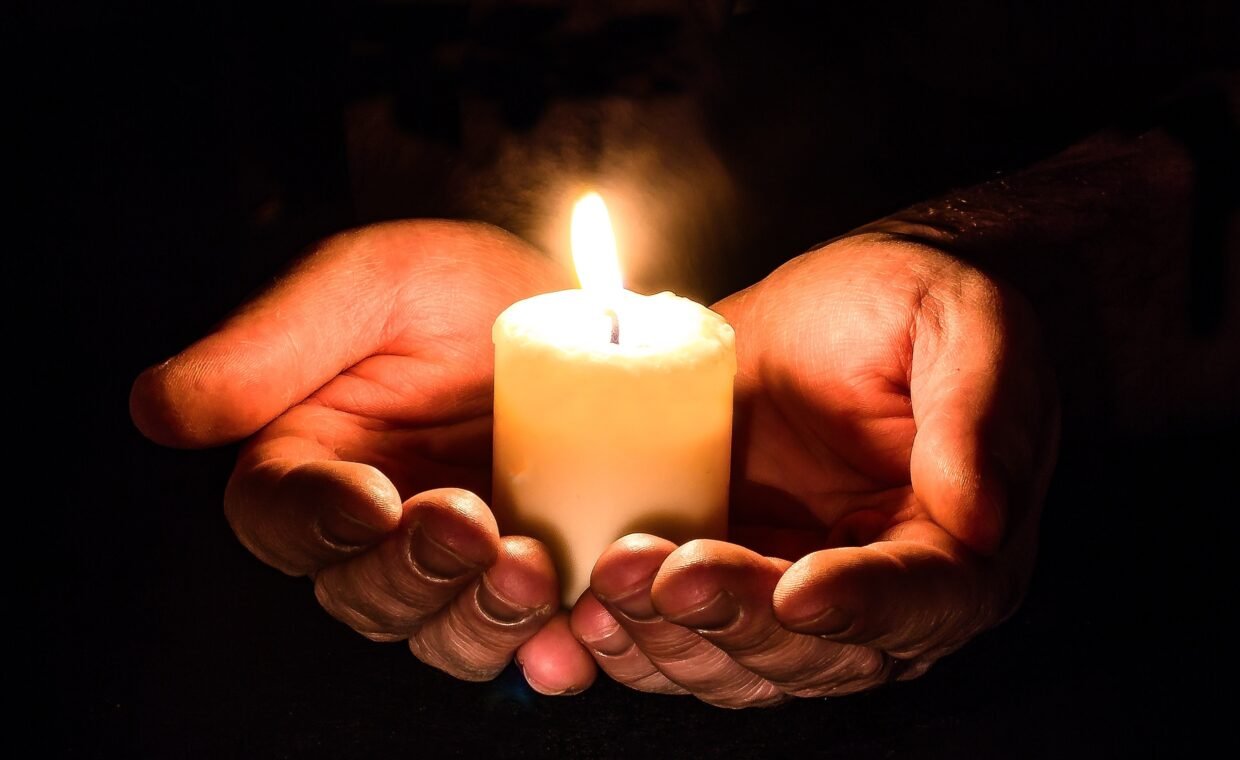
As darkness falls on a Saturday night, what do we do? We Jews light a multi-wick candle that burns brightly as the stars come out. We stand against the darkness of our enemies during the winter nights of Hannukah, building a blaze night after night. Candles in our windows, we don’t accept the dark, we challenge it.
Some three thousand and five-hundred years after Deuteronomy was written — we Jews still care about the mother bird.
Our goal in this life as members of this eternal People is to bring the light of God into this cold, cruel world. To continue to light the match. To hold the line. To separate the shadow from the sun. To distinguish good from evil. It is not easy, it is not a small task. Each of us in our own way, through word and deed, must play a small part in our people’s seemingly impossible task.
When a mother commits a terrible crime, we Jews don’t shrug and say, “Same.” The truth is, Lindsay asked for help over and over. She asked for someone to stay with her. Her husband went on a ski trip. No one stepped up. We need to say to a mother we know is at the end of her rope, “I’m getting you help.” “I hear you.” “I’m going to listen to your story.” “I’m bringing dinner.” “I’m taking the kids.” “We’re going to the hospital.”
When we reach out, when we take that step to be present during difficult and disturbing emotions, we move from shadow to light, from suffering to peace, and we are fulfilling the very reason our souls were chosen to enter this world in the first place.
“Same, Lindsay.”
No. Sorry. We should not be the same as Lindsay Clancy, ever. We can never normalize attention-seeking women creating a heroine out of someone who committed infanticide. Whether or not Lindsay Clancy is found criminally liable, three young children are gone.
Our job is to continue to distinguish between pain and performance, between a person who is seriously struggling and a person making a video just for clicks and “engagement”. Some of them may need help as well — that kind of mimicry should not be entertainment in any context — but at least they haven’t gone as far as Lindsey, at least there’s that.
Not everything is meant to be a spectacle, our eyes should not adjust to everything we see.
We Jews, we light our lights. We do the right thing. With our mitzvot, our Torah, our deeds of goodness, and our tzedakah, we can illuminate the shadows. Perhaps we cannot end the darkness, but we can — we must — refuse to give it the last word.