
There’s a chill in the air in the mornings, have you noticed? I had to turn on the heat for the first time a few nights ago. But that’s all right, it means fall is coming along with all the changes it brings.
I’m excited to experience fall in the High Country. I’ve heard it’s just beautiful, bringing tourists from miles around to drive the Blue Ridge Parkway to go leaf peeping. I’ve seen a few maple leaves starting to turn this week in Blowing Rock.
Around us, the trees — and therefore the mountains — are about to burst into flame in a manner of speaking, amber and bronze, scarlet and gold.
There’s an old song you might know, “The falling leaves drift by the window / The autumn leaves of red and gold…” Maybe you know it from Nat King Cole, maybe Sinatra. It has beautiful lyrics by Johnny Mercer. But did you know that those aren’t the original words? It was based on a French song, “Les Feuilles Morte,” literally “The dead leaves.” How French can you get?
This week’s portion, Shoftim, gives us a series of commands regarding how to lay siege to an enemy town. In Deut 20:19 we read:
When you besiege a town for many days, waging battle against it, to seize it: you are not to bring-ruin on its trees, by swinging away [with] an ax against them, for from them you eat, them you are not to cut down—for are the trees of the field human beings, [able] to come against you in a siege?
Though the English translation poses a rhetorical question, the Hebrew is really just a simple statement, “הָֽאָדָם֙ עֵ֣ץ הַשָּׂדֶ֔ה” — A human being is a tree. Yes, the simple understanding, the pshat, is that trees are not our enemies, don’t hurt them — but I want to take a deeper look at what Hashem is trying to teach here through the lens of Rabbi Gedalia Schorr. He was a scholar and a rosh yeshiva who lived from 1910-1979, considered by many to be the first American “gadol” or “Torah giant.”
In Jewish tradition, there is a significant difference between fruit trees and grains. Both grow from the ground. Both nourish. But they are very different. Side note: one of Adam and Eve’s severe punishments after their expulsion from the Garden was that they had to lower themselves to eat grain from the earth instead of fruits from the garden.
Grains must be resown every year, plowed and planted anew each spring. They are cut down at the harvest and are no more, they disappear. They are fleeting and temporal. Fruit, on the other hand, comes back year after year. Apple trees survive season after season, sometimes for generations. Fall comes, the leaves go brilliant shades as they dry and literally fall. Winter comes, the tree goes dormant but remains alive. And once spring kisses the tree with sunlight and warmth, it blossoms all over again. The tree holds its ground, it continues to grow, it produces something brand new each year.
And so a person should be a tree. Nu? We entered the month of Elul on Monday, the month where we prepare for the Days of Awe. The Sephardim are already getting up at dawn to blow the shofar and recite Selichot — be glad you aren’t Sephardi for once!
But this is not our first season of planting. We’re not grain — as the text tells us, we are trees. We’ve been in Elul before. We’ve come through this time of year many times and, God willing, we will come through many more times to come. We aren’t starting from scratch. This is not our first rodeo. It is not our first renewal.
Rabbi Schorr teaches: A person should work on oneself to such a degree that their strengths, their inner abilities, will reveal themselves almost automatically. The tree will produce new apples in its season.
Every person has incredible ability inside, and you shouldn’t have to start scratching the surface again with plowing. But just as the tree knows that it will have fruit to give and knows that it will produce them in time, you too will get into a routine where it is natural to use your potential and strength. And this is without plowing and planting, this is from growing and continuing, changing and strengthening. Yes, a tree requires weeding and nurturing, but you’re not planting a new tree each year from scratch.
We are the trees. We have survived many a season. Now we head into a time of trembling, a time of fear even — a time when we take stock of our actions and deeds before the Holy One of Blessing. A time of change, growth, and renewal.
We can draw strength from the fact that we are rooted deeply in the earth of faith and tradition, of generation upon generation of growth. We are connected to branches of one another in this tree of life, ready to bear fruit of teshuvah, repentance.
There’s a not-so-old song — well, maybe it’s older than I think — made famous by Peter Allen, “Everything old is new again.” So it is with trees, so it is with us.
I’m a gardener. I get my hands dirty, digging into the soil and the earth. I have learned how to nurture trees and shrubs, how to cut away the weeds, the dead leaves, and how to nourish the growth. I have learned how to care for my trees and help them to bear fruit year in and year out.
What I have learned from all this time in the soil, the weeds, and the flowering trees is that life is about seasons, growth, and renewal. The tree may be old but it will bear new fruit. Last year’s apples are gone. The peony’s roots go deep but every June, new flowers bloom. Everything that is old must be made new to survive and grow. And, in the coming season, every one of us as well.
There is a famous saying of Rav Kook, “Hayashan yitchadeish v’hechadash yitkadeish” — “May the old be renewed, and the new sanctified.”
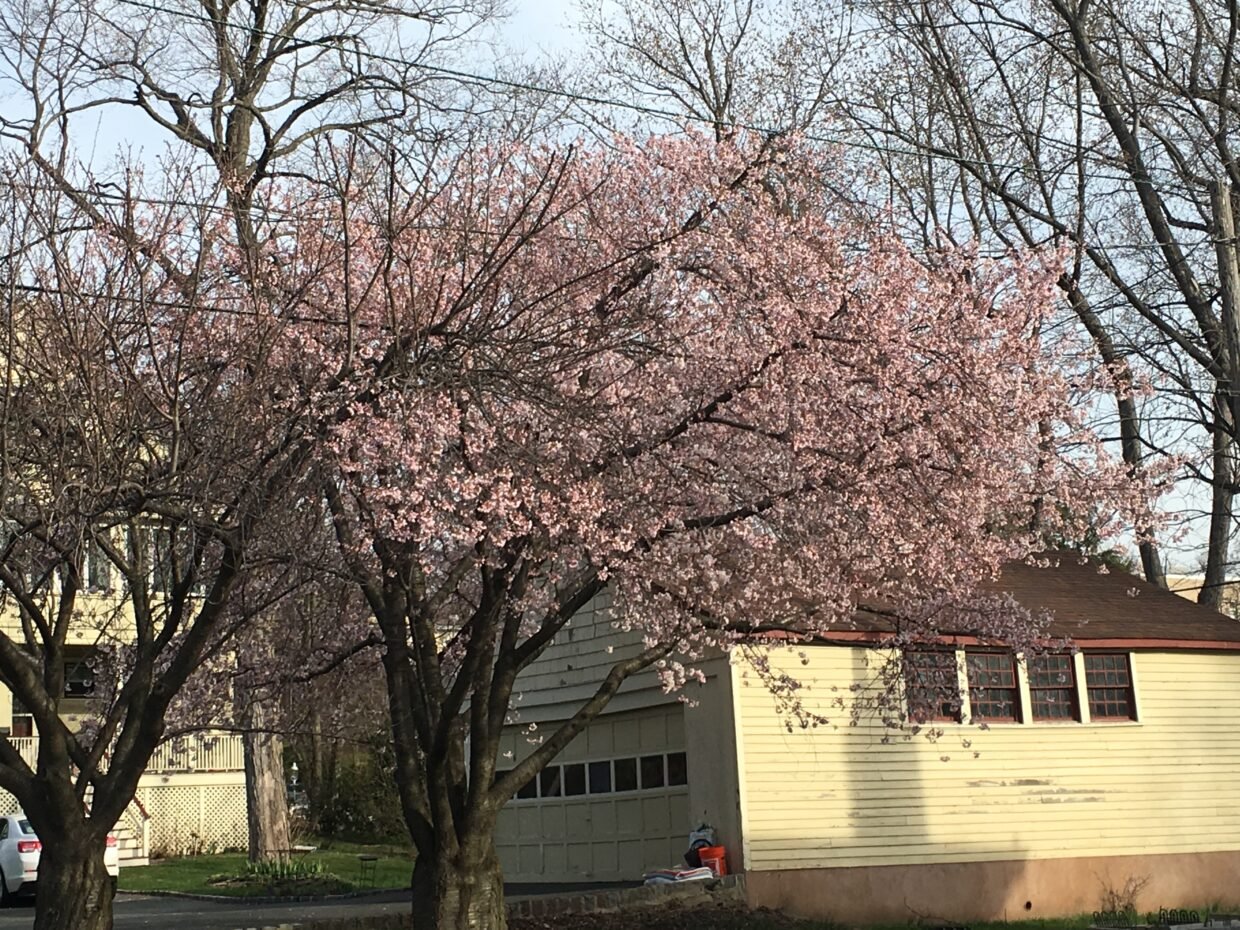
One image I want to leave you with. At the back of my old Victorian house in Glen Ridge, there were two 75 year-old cherry trees. God, I loved those trees when they blossomed in the spring. But there was a problem — there were power lines draping over their top branches.
The electric company didn’t like that — and with good reason!
Every once in a while, they’d send a crew to try and destroy the trees, cutting away willy-nilly without any sense of how to do it properly. I’d run out in my pajamas to shoo them away. And so I tried to protect the trees by having them pruned professionally at my own expense, letting the experts cut them away from the lines in a healthy way. And it worked. The skilled pruning, the light shaping of the old branches made my trees stronger and more beautiful. They could get light and fresh air. Clearing out the dead wood helped these ancient trees send more energy into the remaining limbs and protected us all from the fire hazard. Pruning and cleaning brought more life and more blossoms.
And yes, those trees still stand today.
What is nurtured, grows. What is not, stagnates.
May we all be blessed this coming season, may we all dig our roots deep into the soil of our emunah, our faith. We have stood before HaShem before. We will again. We have faced challenges before — and we will again. In those moments, may we remember scripture, “Humans are a tree of the field.”
We are trees, not grain. In our limbs, in our essence, let us remember that we will bear new, vibrant, fresh fruit from our hearts. Do not mourn the dead leaves for long, just know that new leaves will grow in due time.
And let us have on our lips always the command of the Psalmist in Psalm 98, “Sing a new song unto God, for God has done marvelous deeds.”
Ketivah vachatimah tovah — may you be written and inscribed for good.
Click here to view this sermon.
Joyce Freeman September 3, 2025
Beautiful sermon
Jane Fischer September 7, 2025
My Dear Jess,
As always, your sermon is beautiful and so touching, especially today. Thank you for sharing and I will be ion touch soon.
xoxo