
Third in a series of five sermons on Sacred Mountains
How many of you had an idol when you were a kid? Maybe a sports figure like Joe DiMaggio, Joe Namath, or the ‘69 Mets. Or a movie star like Elizabeth Taylor or Paul Newman. For me, it was Princess Diana. I remember waking up at 3 AM for the Royal Wedding. Hers was the first celebrity death that rocked me to my core. A friend mentioned Jim Henson as the first celebrity death that rocked them. These idols, these celebrities, are people who loomed large to us, people we maybe aspired to be. They were at the pinnacle of their fields whether through talent, beauty, creativity, what have you.
But there is a point where one can become subservient to a goal, a person, or an object, That’s the definition of idolatry. In the past, idolatry was practiced by bowing down to idols, trees, and rocks, but now it means being devoted to people, practices, or things in an attempt to find meaning, purpose, and value.
In the Tanach, the prohibition against idolatry appears no less than 44 times, the most of any mitzvah. It is the second command of the Aseret Hadibrot, the Ten Utterances. In Exodus 20:3 we hear the famous words, “You shall have no other gods before me.” Idolatry was the bane of Israel’s prophets and righteous kings. The Children of Israel turned continually to the native gods and goddesses for plenty. Even as they stood at the foot of Sinai — even after witnessing God’s power — they created the golden calf, a terrible aveirah, sin, which brought wickedness back into the world. Enraged at their false worship, Moses smashed the first set of tablets. Then he destroyed the calf, ground it up, and made them drink its dust.
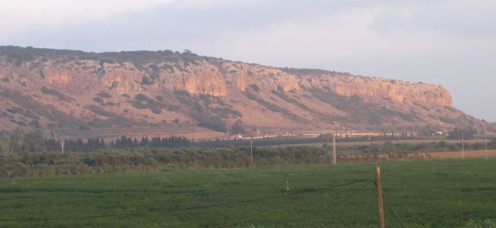
And yet the most famous face off between a prophet and Israelite idolaters took place on this week’s mountain, Mount Carmel. The name comes from the Hebrew word, kerem, meaning vineyard or fruit orchard, and El, God.
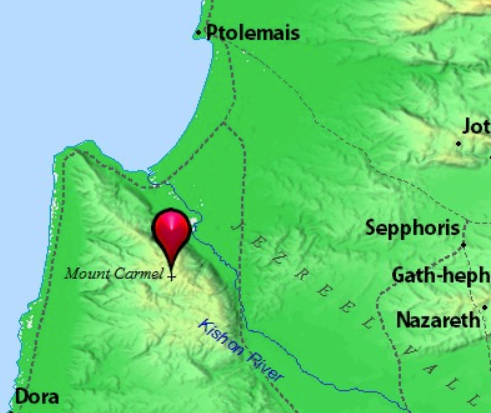
Mount Carmel is a beautifully wooded mountain range which runs for about 13 miles in a south-easterly direction from the shore of the Mediterranean near Haifa to the height of el-Machraqah overlooking the Jezreel Valley.
We are in the section of the Tanach called Nevi’im, the Prophets, and we are squarely in the book of First Kings.
Previously on the Tanach…David and Solomon’s Kingdom of Israel split into two separate kingdoms, Israel to the North and Judah to the south, around 931 BCE. The prophet Elijah was active in the northern kingdom of Israel roughly between 874 and 853 BCE, during the reign of King Ahab. They had many terrible kings who turned away from Adonai and to Baal. King Ahab started out pretty well, but he married a woman you may have heard of, name of Jezebel. Word to the wise: don’t name your daughter Jezebel. Her court supported Baal and Asherah worship, and she went on to kill many of Adonai’s prophets. Because of this, Elijah announced that Adonai would stop life-giving rain and dew for three years.
And so, our story takes place in the midst of a drought and a famine. Elijah took off to go live by a brook where he was fed by ravens, as you do. He was doing fine…and then the brook dried up. God needed him.
The first lesson here is that Hashem will not hesitate to create dry periods and disruptions to get your attention. At times, it can feel like the rain will never fall again. You feel shriveled, desiccated. Relationships dry up. Business slows. Jobs end. Friends disappear. It’s hard. Sometimes, these periods can go on for months, years even. It may not be anything you have done. It may simply be a dry season. This is when we need to stop and say, “What is God asking me to do?” In this moment, Elijah was given a mission.
Elijah returned to settle the score once and for all. He challenged King Ahab to gather 400 of his Baal priests and 450 of his Asherah priests and gather at Mount Carmel for a showdown. Elijah and the priests would each build an altar, slaughter a bull, and wait for fire to descend from heaven — whichever god sent down fire would be the one true god.
But this test was not for the priests, it was for the faithless Israelites. They’d been going in both directions, hedging their bets by worshipping Adonai, but also bowing to and worshipping the pagan gods. They had kept a foot in both worlds. Now, it was time to choose.
With righteous anger, Elijah called to the Israelites, “How long will you go limping from side to side between gods? If Baal is god, serve him. If Adonai is god, serve Him!”
The moment of decision had arrived.
The Baal prophets started calling to their lightning god. “Baal, answer us!” No answer. Not even lightning — and that was his thing! They fell into ecstatic dances, cutting themselves with knives and lances. Harder and harder they danced, deeper and deeper they cut. Blood flowed. And still no reply. They even destroyed Elijah’s altar.
A second lesson: a false idol will always ask you to try harder, to do more and more and more. It is never satiated, never satisfied. Work more hours. Lose more weight. Take more pills. More performance. More sacrifice. No rest for the wicked, keep working, work harder, faster. Keep dancing until you drop. If you find yourself trying to please someone who is never pleased, if you find that your best isn’t good enough, you may be worshipping a false idol. God never says “mutilate yourself” or “dance harder.”
Finally, late in the day, it was Elijah’s turn. He rebuilt the altar with twelve stones representing the tribes and told the people four times to pour water on his altar. He doubled down. The water soaked the wood, running into a moat all around. Finally fire descended from heaven, burning the ox, the wood, the water, even the dust. Complete immolation.
The people fell on their faces and cried out the famous words, “Adonai hu HaElohim!” The same words we sing seven times during the last moments of Yom Kippur, “Adonai — is God.” Rav Yaakov Trump, the mora d’atra of Young Israel of Lawrence Cedarhurst, teaches that this word elohim that we translate as “God” is better translated as “all power.” Hashem reigns alone. There are no other forces.
Last week we learned about Sinai. This is a new Sinai, but in many ways even more powerful. The midrash teaches that at Sinai, God turned the mountain over them like a barrel and said, “Accept or perish.” They lacked free will and a real choice. This time, they had chosen to abandon the God of Jacob. They had made bad decisions. But this time, God accepted them despite their backsliding and half-hearted worship.
The third lesson: depraved people can be a vehicle. At first reading, it might seem that Elijah was battling against the idolatrous Israelites, but Rav Trump brings down the teaching of Rambam: Elijah was fighting FOR the people. His goal was not punishment but a new and better path for people who had lost the way under malignant leaders. The entire test and battle was only so that the people would know Adonai once more.
After the people fell down, Elijah said, “Hold my beer.” (Well, maybe not literally.) He said, “Ahab get going on your chariot because it’s about to pour.” He climbed alone to the summit and placed his head between his knees — some scholars interpret this as remembering the brit milah. There, he waited for the rain.
Seven times, he told his servant to look out to the sea. Six times, the sky was cloudless. Finally, the seventh time, the servant saw a small cloud the size of a human hand, a cloud that grew and grew until the sky was devoured whole — and in the darkness came the downpour.
Ahab got in his chariot and Elijah, with the hand of God on him, hiked up his robes and sprinted ahead of the galloping horses. Limping became running without weariness.
The fourth lesson: anything is possible. The fire from heaven. The rain from nowhere. The speed of Elijah. Our God is a god without limits. The God of Sinai and the God of Carmel is greater than any force in this world, and the very existence of the People of Israel is proof of God’s power.
A final maise. In 1912, there was an inventor in France named Franz Reichelt. He had an idea for a parachute-type outfit, and he wanted to test it by throwing a dummy in the caped contraption from the top of the Eiffel Tower. With permission, Franz went to the platform at the top with his friends to celebrate and have a party. How French can you be?
Once there, he put the suit on himself. His friends were aghast. They tried in vain to coax him away from the edge, but Franz believed in his suit. He had faith in the works of his hands. No one and nothing could dissuade him. With a wave, he leapt off the platform…only to fall to his death. The impact left a 6” divot in the ground.
Our idol may be ourselves. Our “influence” on social media, or perhaps conspicuous consumption, various ways of looking for that dopamine hit to fill the emptiness. And it’s never enough. We fill garages and attics and we still keep buying. Some worship control and superiority, trying to dictate the actions of those around them. They step off the platform, confident in their ability to fly…or at least to fall with grace.
So. The final lesson. We must understand that we are made in God’s image and that we have an unbreakable covenant with a God who loves and accepts us. When we do, we will see that, just as Hashem brought rain to the faithless Israelites, we can let go of all our false idols at last.
Earlier tonight we read the prayer, “Ahavat Olam.” “Endless is your love for your People Israel.” God’s goodness and approval are not based on what you have, where you live, or your social status. You just need to be who you are.
Every single day, we stand on Mount Carmel. We limp after empty gods, even I’m guilty of that sometimes. And look, I can’t bring down fire, I can’t bring down rain. (And goodness knows we could use it.) But there is one thing I can do…
Like Elijah, I set before you two choices. If your false god is real, follow it. But if Adonai is God, follow Hashem. The choice is yours.