
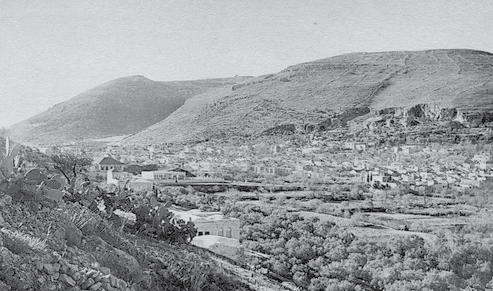
First in a series of five sermons on Sacred Mountains
I’m still not used to living in the mountains. I know, patience, it’s only been three months. Still, it’s a long way from the New Jersey Turnpike. To be fair, the Appalachian mountains do stretch through the northwestern corner of Jersey, but they’re nothing like Mount Mitchell, Grandfather Mountain, or even Beech Mountain.
Up here, there are peaks wherever you look, mountains all around us. Each holler and valley has its own legends and tales. Each river moves in a unique path. Each peak has its own majestic beauty. There is a peacefulness. For me, there is a sense of isolation from the rest of the world. “Coming down the mountain” to go shopping or see a doctor is a whole day. Again, only three months, but already, I feel connected to the rolling green peaks, now turning red, yellow and bronze.
Did you know that the Hebrew word, “Har/הר” or “mountain” is mentioned more than 560 times in the Hebrew Bible? Over and over, our ancestors named mountains, climbed them, and encountered the Holy One of Blessing atop them. Over the next few weeks, I want to explore five different mountains in our tradition. Together, we will discover texts, teachings, and legends that will hopefully bring us closer to understanding these heights.
In the book of Deuteronomy, the Israelites are commanded to destroy all the pagan altars and sacred trees when they enter the land. Instead they are to gather in,
כִּ֠י אִֽם־אֶל־הַמָּק֞וֹם אֲשֶׁר־יִבְחַ֨ר יְהֹוָ֤ה אֱלֹֽהֵיכֶם֙ מִכׇּל־שִׁבְטֵיכֶ֔ם לָשׂ֥וּם אֶת־שְׁמ֖וֹ שָׁ֑ם לְשִׁכְנ֥וֹ תִדְרְשׁ֖וּ וּבָ֥אתָ שָּֽׁמָּה׃
…. the place that Adonai, your God, chooses from all your tribes to set God’s Presence there, you will seek God’s Presence and come there.
What is this place? This Makom? Our sages understood it to be Mount Moriah, future site of the Beit Hamikdash, the Holy Temple. This is the place where God’s glory will dwell. This is the place where heaven and earth will touch. Altars will be built. Animals sacrificed. It is the sacred site where the veil between worlds is thin. On this mountain, among the people of Israel, God will make a home. According to Rambam, this site will grant us eternal atonement.
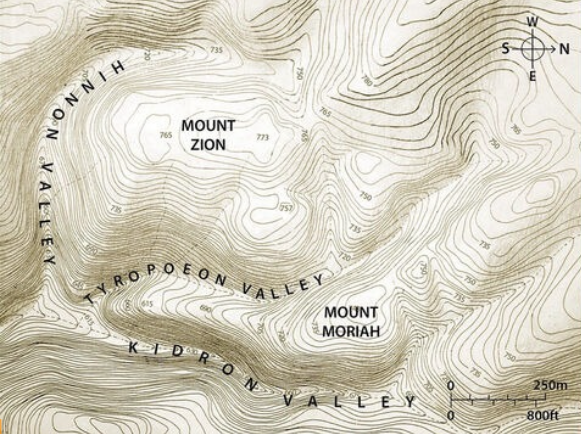
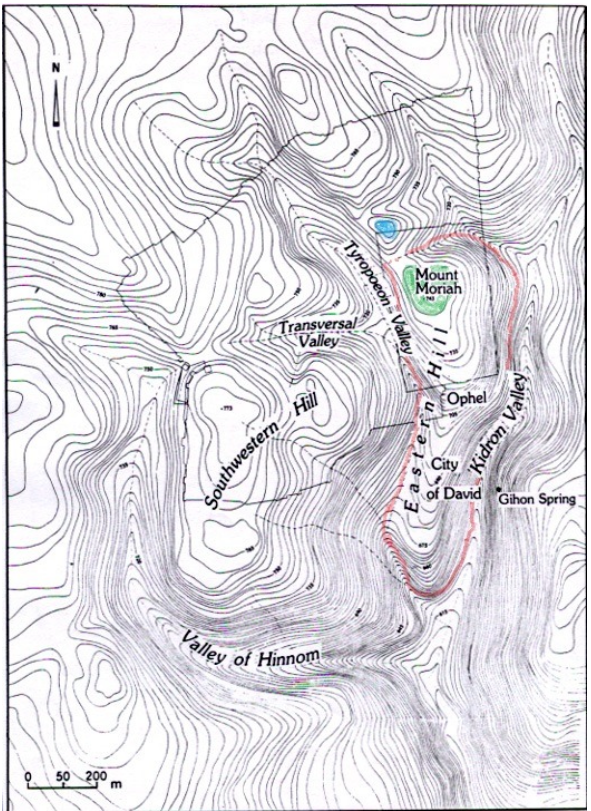
Let’s get situated geographically first (show map on screen). Mount Moriah is less mamash a mountain and more of a long mountain ridge. It sits at only 2500 feet. It is the name of the elongated north-south stretch of land that lies between Kidron Valley and Hagai Valley, between Mount Zion to the west and the Mount of Olives to the east. It seems higher because it is surrounded by deep valleys which used to be even deeper.
If you place the walls of the Old City around it, it looks like this. We can see the Har Habayit, the Temple Mount, placed on the summit of the ridge.
Now that we are oriented topographically, let’s look at why this particular mountain became the most sacred place in Judaism.
It began with Adam. Legend has it the very dust of the earth from which he was created was taken from Mt. Moriah, and he later sacrificed there. His sons, Cain and Abel, gave their ill-fated sacrifices there. Then Noah and his sons also sacrificed there once their Ark reached land. Finally, Abraham and Isaac. This was the site of the Akeidah, the Binding of Isaac. the ultimate test of faith.
How did it come to be the site of the Temple? After Abraham, the location of Moriah was hidden from us for 400 years. We hear nothing about it. But in II Chronicles we read of its second revelation. King David, against the wisdom of his advisors and at the prodding of the Satan, decided to take a census of men to determine his fighting force. Israel had already been given a way to count itself — other ways were forbidden, but David wanted to do it his own way. He was adamant, but he would pay a price in the end.
So a prophet named Gad gave David three options for punishment: Israel could endure three years of famine, three months of being killed, or three days of a plague. David chose the plague, but as it started to decimate his men — some 70,000 died — he had a vision. He saw the Angel of the Lord standing at the exact place the Mikdash would be built. The threshing floor of Ornan the Jebusite. The sword of the Angel was drawn, ready to strike. The people hovered between life and death.
Suddenly David was repentant, “I am the one who said to count!” The Angel held back and instructed him, “You are to build the Altar right here. This is the cure to stop the plague.” He purchased the threshing floor for 600 gold shekels, built an altar, and immediately made a sacrifice. Eventually, his son, Solomon, would erect the temple where this mercy, this atonement, would forever serve the Children of Israel.
This holy place is where Adonai moves from judgement to mercy. Its essence is kapparah, atonement, at one-ment. It is integral to the Jewish people to this very moment. This is why we pray at the Kotel and seek to come near to it. We need God’s rachamim, compassion. It is a place to repair, restore, and renew. It is a place to continue our relationship with the Holy One of Blessing in this world. Our connection is not merely physical, it is our very ability to live in this world.
And what of the name? Moriah. What does it mean? Some of our sages say it comes from the word for teaching, “hora’a.” Others say it derives from the word, “yir’ah” fear. There are countless other explanations, but I want to share a teaching from Rabbi Meir Goldwicht that changed me.
Literally the word, “mor” in Hebrew is myrrh. Myrrh is a resin produced by a tree that grows in Ethiopia and Somalia. This resin was an important part of the sacred incense, the ketoret, burned twice daily in the Beit HaMikdash. And so myrrh is not native to Israel.
The medieval rabbis thought that myrrh was the dried blood of an animal that lived in India. In their imaginations, it came from one of the places farthest from Eretz Yisrael. The Ra’avad, a 12th century mystic, was outraged. How could the blood from an unkosher animal enter the Holy of Holies? The 13th century rabbi, Joseph Caro, answered that after it had dried, it became a fragrant powder that was indeed permissible.
But Rabbi Goldwicht went farther.
That this myrrh came from continents away means this: no matter how far away you may be from Yiddishkeit, the door is never closed. You can walk in and join us 24/7. The gates are open, the doors wait for you to walk through. Those from a so-called distant land are still an essential part of who we are as a people. Anyone, even those who have left, can return and be connected to amcha.
In other words, it’s never too late. Hang a u-turn, make a 180, no matter how far away. You’re never too distant. Come home.
The Psalmist asks us: מִֽי־יַעֲלֶ֥ה בְהַר־יְהֹוָ֑ה וּמִי־יָ֝ק֗וּם בִּמְק֥וֹם קׇדְשֽׁוֹ׃
Who may ascend the mountain of Adonai?
Who may stand in God’s holy place?—
נְקִ֥י כַפַּ֗יִם וּֽבַר־לֵ֫בָ֥ב אֲשֶׁ֤ר ׀ לֹא־נָשָׂ֣א לַשָּׁ֣וְא נַפְשִׁ֑י וְלֹ֖א נִשְׁבַּ֣ע לְמִרְמָֽה׃
One who has clean hands and a pure heart,
who has not taken a false oath by My life
or sworn deceitfully.
Each of us can ascend the mountain of Adonai. Nno matter how disconnected from our heritage, from our Jewish lineage, each of us can ascend and be welcomed onto the Holy Mountain. It is always there, waiting.
Australian mountaineer Greg Child once said, “Somewhere between the bottom of the climb and the summit is the answer to the mystery why we climb.” That mystery will be different for each of us, the destination as well. It may look like a summit, but only you can know what you see there.
May we discover the answers to our mysteries as we scale the heights.
May we all merit such an ascent, whether literal or metaphorical.
And may our eyes always look to the hills and that which we seek and will find there.