

Here’s a question. Who here has taken a selfie? You do know what a selfie is, yes?
It’s a self portrait you take with your phone, of course. How many of you have taken one before? How many have shared them? They seem to be a rite of passage when you get a new phone these days, doesn’t matter young or old. I promise, you’re not too old! They’re a fun way of saying “Hey, look at me! I’m having a day at beach, I’m at a cool restaurant, I made it to the Taylor Swift concert.” (And let me tell you, that wasn’t easy!) They’re fun to share with the world or maybe just the one person who’s the world to you. “Hineini” they say. Here I am.
Selfies can be fun and positive. I treasure the ones I have with my girls or those I’ve taken at special places in my life. But they can be dangerous both physically and emotionally. Studies have shown that for teen girls, selfies can diminish their self-esteem and lead to having a negative body image. And we have all heard tragic stories of people falling off cliffs and ledges trying to get that perfect shot.
So, what is a selfie really? At heart, it is a mirror, a reflection. We see ourselves. Maybe we use a filter, we idealize. Maybe we don’t, maybe it’s simply a version of our reality. Maybe this is the image we want to present to the world.
In this week’s parsha Vayakhel, we learn about the danger and power of mirrors. The Israelites are preparing the Mishkan, the traveling Sanctuary where God’s presence will abide and where they will worship. One object they need is a bronze basin where the priests will purify their hands and feet with water. We read in Exodus 38:8 “Betzalel made the basin of bronze and its stand of bronze, from the mirrors of the ministering women who ministered in the entrance of the Tent of Meeting.”
Such a small verse. A minor detail in a giant architectural plan that takes over many chapters. But let’s take a closer look.
In the ancient world, including Egypt, archaeologists have found examples of small, round, highly polished bronze hand mirrors used by women. How did slave women come to own such objects, and what did they do with them during their centuries of enslavement? And why would these objects of vanity be used to create sanctity?
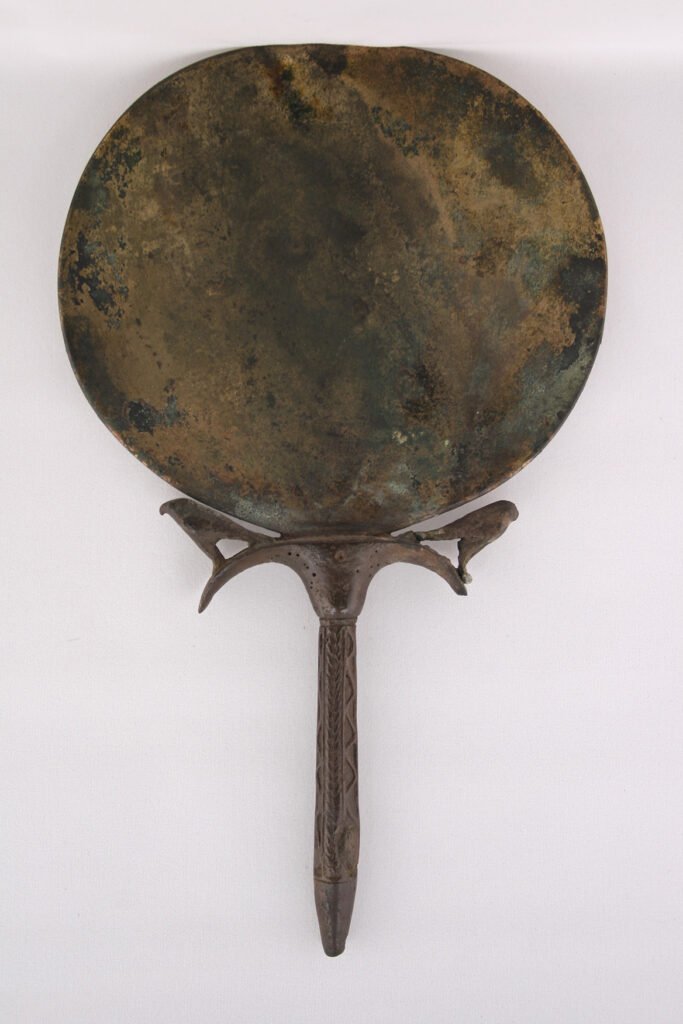
Rashi brings the Midrash that Moses was going to reject the offering of these ministering women. To him, these were objects of self-glorification and even haughtiness. In Midrash Tanchuma, Moses calls for these women to be beaten with canes! But the Holy One Himself enters the conversation and countermands Moses, “Accept them!” He commands. “These are dearer to me than all the other contributions because through them the women reared those huge hosts in Egypt!”
How so? It turns out that when the men of Israel returned to their homes after a day of crushing slave labor, they were exhausted. The Israelite women brought them food and drink. Then, the women would take their mirror and playfully hold it up so that both she and her husband were reflected. “See,” she would tease, “I am handsomer than you!” This awakened the (ahem) affection of the men and yada yada … you can guess what happened next. That’s right, there was a population boom.
Author Jennie Pollock notes that the women then gave these mirrors willingly, because they no longer cared if they looked good in the morning. They no longer had to check their faces for marks or blemishes. They were caught up in love and service to Hashem. Things that once seemed important faded away. This happens often in parenthood. Where once you wouldn’t dream of leaving the house without hair and makeup, a lot of new moms find themselves heading to the store in sweats and a baseball cap. The time, the labor, the effort…they just want to get the groceries. People whose homes looked straight out of Architectural Digest have a few kids and just like that, the floor is cluttered with paper, crayons, and plastic toys.
What was important on the surface, what was for show, is no longer critical to who you are. And maybe it never was. You don’t need that mirror, that selfie, that SELF, anymore. You serve something larger, more transcendent. You are more than your surface appearance, and you always were.
In Peninei Halacha, a modern compilation of Jewish laws, Rabbi Eliezer Melamed notes that every great event that happened to the Jewish people was made manifest by its women. The women preceded men in the path of faith: in the merit of the righteous women, the people of Israel left Egypt. At the giving of the Torah on Mt. Sinai, the women were addressed first (Ex. 19:3). Our sages teach that men learned how to honor Torah through women and that men today learn Torah in the merit of women’s insight (Berachot 17a). Women neither participated in the making of the Golden Calf nor in the sin of the spies. Mesorah, tradition, is clear. The support of women, who were understood to be spiritually superior, was critical at every step of the journey.
What seemed vain at first glance was primarily used to perpetuate a people. The yada yada, in other words. What seemed frivolous to a bystander would come to sanctify the priests who only then could purify others. The women might not have been allowed inside the Tent of Meeting, the Ohel Moed, but the text states clearly that they were just outside ministering. Perhaps they were providing food and water, perhaps healing with herbs and poultices. Maybe they were holding up the weak and infirm, widows and strangers. I can see Miriam prophesying there among her people. We can only imagine our foremothers standing in their strength as the mishkan came together. Because we know they were there.
Some therapists and psychologists encourage people to take a selfie every single day. They can be a way for us to track our moods and feelings. For some, they can serve as a visual diary— capturing memories and experiences, moments we want to remember. For others, it helps build a positive self-image—look how far you’ve come, look how beautiful you are! And they don’t have to be so serious or weighty, they can just be light-hearted fun.
When our time here is done, our children and grandchildren will have hundreds, maybe thousands, of photos of us to share and treasure. Moments to remember and hopefully cherish. Our grandparents and great-grandparents may have left us with only a few old photos or scrapbooks to remember them by.
So tonight, tomorrow, whenever, why not take a selfie? Take one alone or with friends or family. Take one in your backyard or a park or a museum. Take one because you want to capture a moment, a mood, a memory.
Celebrate the now we are blessed to be in. We are alive. We are smiling. We are present.
We are here.
Shabbat Shalom.
Learn even more about this Egyptian mirror if you’re curious.