
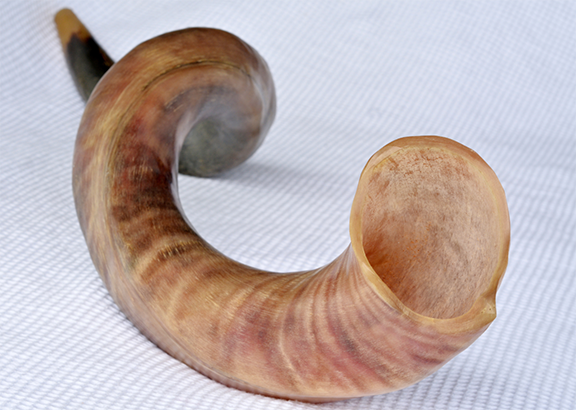
One of my proudest moments was the year my eldest, Annabel, was the baalat tekiah (shofar blower) at our Second Day Rosh Hashanah service. She is an accomplished flutist and played the mellophone in marching band.
Even as a child, she would blow the giant Yemenite shofar that I had brought home. By the age of ten, she was blowing that tekiah gedolah better and longer than most anyone we’d ever had on the bimah.
As a result, she knew how to form an embouchure. Just as important, she knew how to control her breath for maximum effect. We practiced until she knew the names for the specific calls and had the sounds halachically correct. I’m sure the neighbors loved it — unlike here, in Glen Ridge, you can reach out your window and almost touch the house next door. I am not even kidding.
Finally, it was the second morning. When it came time, I couldn’t even look at her, my nerves were shot. I focused on the text and called out, “Tekiah!” “Shevarim” and “Teruah.” Each blast was clear and accurate.
Thirty blasts in different combinations, then it was time for the final gedolah. So far, so good. I knew she’d be great. And yet. My heart was in my throat, this was the big one. And you know what? This slip of a girl in a mini-skirt and Doc Martens let out a sustained, solid, powerful blast that blew the roof off the sanctuary. It was close to two full minutes!
It was the longest gedolah that anyone there could remember. When she finished, the kahal burst into applause. She went back to her seat, floating on cloud nine.
But that isn’t exactly why I was so proud.
You see, she has always been a very shy person. I knew she would be amazing, but over the years, every time I offered, she would shy away. It hasn’t been her nature to want the spotlight. And yet, when she heard the call, when she was ready, she was amazing.
That took knowledge, courage, and power. But these were always a part of her, waiting to be awakened.
So nu? Shofar. What is it? What does it mean? Why on this day of days do we need to hear it?
Today, Rosh Hashanah, the beginning of the year, is the day that Yoseif HaTzaddik, Joseph the Righteous, was freed from prison.
In Psalm 81 verses 3-7 we read;
תִּקְע֣וּ בַחֹ֣דֶשׁ שׁוֹפָ֑ר בַּ֝כֵּ֗סֶה לְי֣וֹם חַגֵּֽנוּ׃
Blow the horn on the new moon,
on the full moon for our feast day.
כִּ֤י חֹ֣ק לְיִשְׂרָאֵ֣ל ה֑וּא מִ֝שְׁפָּ֗ט לֵאלֹהֵ֥י יַעֲקֹֽב׃
For it is a law for Israel,
a ruling of the God of Jacob;
עֵד֤וּת ׀ בִּיה֘וֹסֵ֤ף שָׂמ֗וֹ בְּ֭צֵאתוֹ עַל־אֶ֣רֶץ מִצְרָ֑יִם שְׂפַ֖ת לֹא־יָדַ֣עְתִּי אֶשְׁמָֽע׃
He imposed it as a testimony upon Joseph
when he went forth fromthe land of Egypt;
I heard a language that I knew not.
הֲסִיר֣וֹתִי מִסֵּ֣בֶל שִׁכְמ֑וֹ כַּ֝פָּ֗יו מִדּ֥וּד תַּעֲבֹֽרְנָה׃
I relieved his shoulder of the burden,
his hands were freed from the basket.
The shofar in verse 3 is the key – the shofar is the preeminent symbol of freedom. We know this because it was blown on the Jubilee year, the 50th year of the cycle, to announce the release of Israelite slaves from their servitude. The very fact that a shofar was being blown as Joseph left prison – as he was moving towards freedom himself – means it occurred on Rosh Hashanah.
When else did the Children of Israel hear the sound of the shofar? Anyone? That’s right, Har Sinai, Mount Sinai. At the giving of Torah, chazal teaches us that there were two distinct sounds — the sound of a voice proclaiming the aseret hadibrot (the Ten Utterances) and the sound of the shofar. Rambam gives insight on how to pay attention to these sounds. The words, the “dibrot” were even and steady. They did not grow louder. But the kol shofar continued to get louder and louder throughout the revelation on Sinai. The people trembled in fear as it roared on the mountain.
Our tradition teaches us that every Jewish soul that ever was or will ever be stood together at Sinai. You, me, all of us were there. We all heard these sounds long ago. We hear them still today. But why?
There is a concept in Judaism of kavod haTorah. As part of honoring Torah, we are commanded to give honor to a Torah scholar who has completely forgotten his learning. This is different from the mitzvah of honoring the elderly. Rashi teaches us that when a righteous person leaves a city, the city is not the same — this person has left an imprint. Similarly, when a Torah sage, due to age or illness, has forgotten their Torah — even if they have forgotten every single line and verse — the sanctity of Torah which was once embodied in this person remains. Where there was once holiness, some imprint of it continues on. Forgetting in their present doesn’t negate the wisdom of their past.
The tzaddik leaving the city, the Torah leaving the scholar — where does this all come from? The fragments of the first tablets of stone Moses brought down from Sinai and smashed were not discarded. They were kept in the Ark along with the second complete set of commandments.
Now the letters that had been on these first luchot were no longer there, they flew away when Moses saw the worship of the Golden Calf. What remained were literally blank shards of stone. What words had been — gone. The torah of the old scholar — gone. The tzaddik has left the city. But each of them left an imprint. Holiness, like energy in the universe, cannot be totally destroyed.
Today, chevre — WE are the old scholar who has forgotten their learning. But despite this forgetting, we live in a world where the first luchot WERE STILL GIVEN. Yes, they were shattered, but still they entered the world, they were a gift to the Jewish people who at that moment attained a level of kedusha that will not be seen again until the coming of Mashiach. At that moment every Jew received the ability for prophecy. At that moment a light shone into the world that is now faint and dim — but my friends, it CAN BE REIGNITED.
We may be asleep, but the power of Sinai, like the lost Torah of the old scholar, is there even now, but it is hidden from us. We don’t sense it or know it is there, but mamash we HAVE IT. Try this. Think about what might happen if your computer were wiped clean. Scary right? Everything erased, the code all gone. But maybe you have a Mac and you were using Time Machine. Or maybe a PC and you use Backblaze. Maybe you didn’t know you could have your computer backed up somewhere, ready to restore, recover, and revive.
That’s how we are operating, but with Torah.
Over generations Torah has been lost and forgotten, we’ve been asleep, but the power of that very first revelation is STILL THERE, we just can’t access it. A word of Torah is never fully gone. Our rabbis teach that when we die, all of the Torah we learned and forgot in our lives will be returned to us in the next world. When Mashiach comes, all the forgotten Torah of our people will be brought back — not TAUGHT AGAIN but remembered.
Think of DNA found buried in ice. Some scientists are trying to use this genetic code to recreate a wooly mammoth — all the data is there, it is a literal code, it’s just been hidden, lost in hibernation.
The code of Torah is in you. You are an archive. You stood at Sinai. Within you lives Rambam, Akiva, the Baal Shem Tov. The previous generations speak to us but we cannot always hear them because we are in a deep slumber. The fragments and pieces, the words and ideas, the code — these are all still inside of us, waiting to be made whole again.
I know what you’re thinking. Ok rabbi, nice story, but I thought you were telling us about the Shofar.
I am.
Yes, the Shofar is just a ram’s horn. And when someone blows, it can make a few sounds. That is the most basic definition of what it is. We must also look deeper. Maimonides tells us — it is the shofar that wakes us from our slumber. Sinai. It’s in us. Nevuah, prophecy, it is in us. What lies dormant is aroused by these primitive calls. The shards are repaired and restored. We restore, recover, and revive. THAT is why we are commanded to hear Shofar.
Here, together, hearing these sounds, we return to our true selves. Look inside — you may sense it and feel it, no matter how dimly. The shofar is key to remembering who we were, who we are, what we can be, and what we WILL be in the Time of Mashiach, the time of completeness.
I remind my b’nai mitzvah students on their special day that they are the children of kings, queens, prophets, judges, warriors, and tzaddikim. Our Judaism cannot just be bagels and matzah balls, Mel Brooks and pastrami. Our children must know where they came from and where they are going.
We are not just a bunch of nice Jewish people socializing in Boone, North Carolina or wherever we may be. Within us — yes, all of us — God has placed the entirety of Torah: the light, the power, and the glory of Sinai. This is what it means to be a Jew.
Today, I want you to listen and to awaken. I want you to see yourself at the foot of the mountain. We were there once. With God’s help, we will stand there again, arm in arm at the End of Days.
Many believe they are close. We may well be living in Ikvei HaMashiach, the final days.
Whenever the Final Day arrives, the tablets of our hearts will remember all we once knew. The letters will return. The world will be filled with the knowledge of HaShem, and we will all know only peace and unity, rest and serenity forever.
Whether we are old and have forgotten — or maybe even left the village — or we are a young slip of a girl in Doc Martens, we will remember, we will recover, and we will revive. It will take courage, knowledge, and power, yes, but these have always been a part of who we are, each and every one of us.
Let us remember to keep listening, ready to hear — and to heed — that clarion call when it comes.