
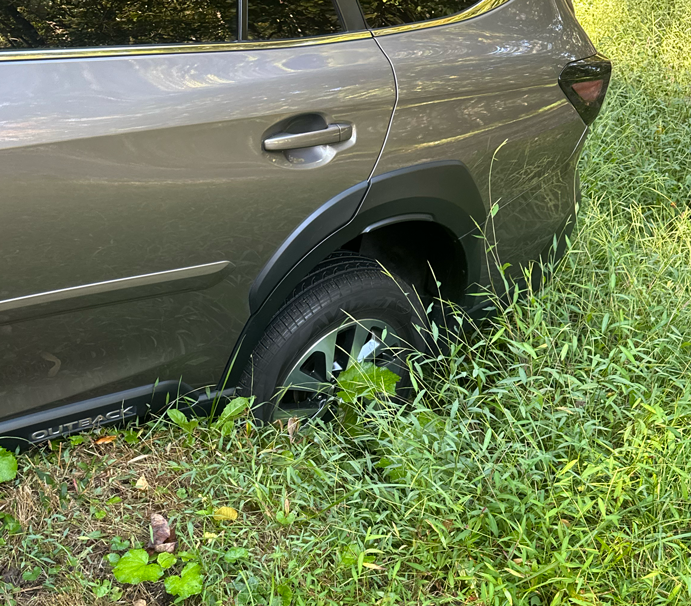
Well, it took two and a half months, but it finally happened.
Yesterday, I had to get winched out of a ditch on the side of a gravel road. Supposedly, this is a rite of passage up here in the High Country. Consider me baptized. On the plus side, at least it didn’t involve actual water…
Long story short, I trusted Apple Maps and a typo in the address and wound up a little farther than I needed to go along a gravel road. Once I realized my mistake, I looked for a place to turn around. There were no convenient turn-offs or driveways. I tried to back up to an intersection but it was hard to see. So okay, time for a K turn, no big deal.
Next thing I knew, there was a huge CLUNK as the back tires fell into a steep ditch hidden by tall grass. I was good and stuck.
As I waited for the tow truck, a Subaru came driving down the gravel road and stopped, and an older man got out.
“Yup, we get one or two of these a week.”
After a few minutes of chitchat, I said, “Oh I hope I’m not blocking your way!” thinking that he had been heading somewhere and just stopped to see what was what. “I’m fine.” We kept talking. “Could’ve been worse,” he said. He wasn’t wrong.
Once the tow truck appeared and pulled the car out—it took all of a couple of minutes—I still had to figure out how to get back out to the main road safely.
Rather than try another 3-point turn, I decided the simplest thing would be to reverse down the road. It was curved, but not terribly. And who was guiding me and keeping me out of the ditches? That’s right.
As I reached the end of the gravel road, I rolled down the window and said, “Thank you!!!” He waved and headed back up the road.
Here’s the thing. He wasn’t headed out. He wasn’t going anywhere. He saw me get stuck and drove down to help. A complete stranger!
Look, I’m just a Jersey girl. Things like that really don’t happen up there. But here? Just being a good neighbor, standing together.
This week in the Torah, we’re also standing together. It’s a parsha called “Nitzavim.” which literally means, “standing.” The Children of Israel are about to enter into yet another covenant before they enter the Land of Promise.
We read in Deuteronomy 29:9:
אַתֶּ֨ם נִצָּבִ֤ים הַיּוֹם֙ כֻּלְּכֶ֔ם לִפְנֵ֖י יְהֹוָ֣ה אֱלֹהֵיכֶ֑ם רָאשֵׁיכֶ֣ם שִׁבְטֵיכֶ֗ם זִקְנֵיכֶם֙ וְשֹׁ֣טְרֵיכֶ֔ם כֹּ֖ל אִ֥ישׁ יִשְׂרָאֵֽל׃
“You stand this day, all of you, before your God יהוה —your tribal heads, your elders, and your officials, every householder in Israel, your children, your wives, even the stranger within your camp, from woodchopper to water-drawer—”
I want to give you a very simple drash tonight. Sometimes, simple is best, especially as we prepare for the marathon of prayer coming our way.
Atem Nitzavim Hayom. Hayom means today. You stand together today.
Nu? Why is this written in the present tense? This happened generations ago, thousands of years ago, but every single time we open the Chumash we see the word “hayom” – today.
Rabbi Moshe Weinberger brings down a teaching of the nineteenth century Chassidic master Rav Leibele Eger. Eger’s message is profound as we stand tonight in the time period called, “the gates of Jerusalem.” These are the powerful days between Selichot and Rosh Hashanah.
Hayom. Today you can be different.
Hayom. Today you can change your life.
Hayom. Today you can start fresh.
No matter where you are, who you are, what you have done, our Torah teaches very clearly and directly — not in riddles or in secrets — that in this very moment, you can change. There is no bad time for a Jew to renew because for us every single day is hayom — a day of standing and returning. There is nothing in your way.
You may say, “Sure rabbi, that works for some people. Some people can change but not me… I’m too old. I’m too tired. I’m fine how I am. I get by ok.“ This isn’t about “getting by ok”. No one is excluded from this hayom.
If you are a living, breathing, caring person, you are capable of learning, change, and growth today and every day.
Let’s look at the text. After telling us that we all are standing together, the Torah lists everyone in the community from great to small, top to bottom. Chieftains, women, children, converts, shleppers, wood cutters — everyone is included in this moment of possibility. Everyone is capable. All of our souls were there. All of us stood. You were there too. I know, because so was I.
Rav Eger teaches that at this time of year, Hashem is screaming at us, yes, screaming at us, “Stand up and be with me!” Hashem is begging us to get close, to come home, to come back. Rich, poor, old and young — we are equal in our chance to make this hour, this minute, this second the one where we turn to our true nature, where we keep the oath, that Chazal, our sages, say we all made in the womb before birth. We pledged at that time to an angel “to be righteous and not wicked.”
And now that moment has come. Our oath must be kept.
There is a difficult passage coming on Tuesday. It’s from a challenging Medieval liturgical poem called “Unetaneh Tokeif.” In one famous passage, the poet imagines that on the Day of Judgement, Yom Hadin, we are all walking before Hashem one by one to be judged in the same way that sheep walk in a single line before a shepherd. In this poem, it imagines that we all walk alone.
A maise. A chassid once went to the Slonimer rebbe before Kol Nidre in tears. He was filled with terror as he knocked on his rebbe’s door. “Rebbe,” he said, “I am so full of sin and filth, how can a person like me go to Yom Kippur?”
The Slonimer rebbe stroked his beard and said, “Yes, yes. I was wondering the same.” The man gasped. “You were wondering that about me?”
“Oh no, I was wondering that about myself. How could a person like myself possibly go to the aron hakodesh.” The rebbe paused. “However, one Jew with another Jew…we can certainly walk in together.” He placed his hands on the chassid’s shoulders and said, “Come, join me, let us go.” And, arm in arm, they walked to say Kol Nidre.
Soon it will be Yom Hadin, the Day of Judgement, and we will stand to be judged. But know this — you’re not alone. And you do not have to walk alone.
I’ve learned in just this short time that this community, this kahal, is a family. Neighbors, relatives, looking out for one another. Mishpacha.
With hands on one another’s shoulders, eyes looking up, hope in our hearts, souls ready to change…b’ezrat Hashem, come, let us walk in together.