
Have you ever heard of Rabbi Benjamin Cassius LeRoy? He was born in Alabama of all places, became a rabbi, and emigrated to Canada where he served at Temple Israel in Ottawa in the 1920s.
A fire broke out in the temple on April 14, 1929. The flames engulfed the building, destroying the synagogue and much of its contents, including their valuable torah scrolls. Arson was suspected as there was a wave of anti-semitism at the time.
He moved to New York where he met and married an artist named Ruth. They had four children, two sons and two daughters. The eldest son, Bernard, followed in his footsteps to become a rabbi right here in New Jersey, serving at both Temple Beth Shalom here in Livingston as well as Congregation B’nai Jeshurun in Short Hills.
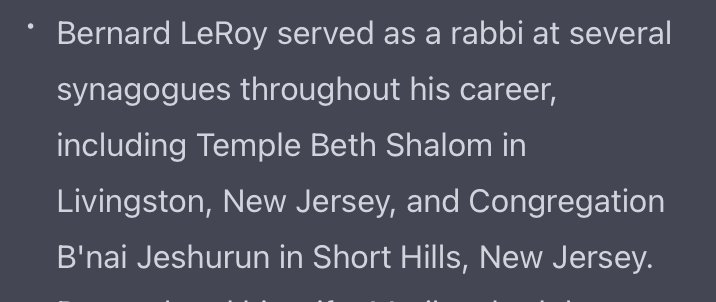
Bernard’s daughter, Yael, also went into the family business. She trained at the Reconstructionist Rabbinical College in Wyncote, Pennsylvania, and was ordained in 2001. She currently serves as the spiritual leader at Congregation Shir Ami in Castro Valley, California.
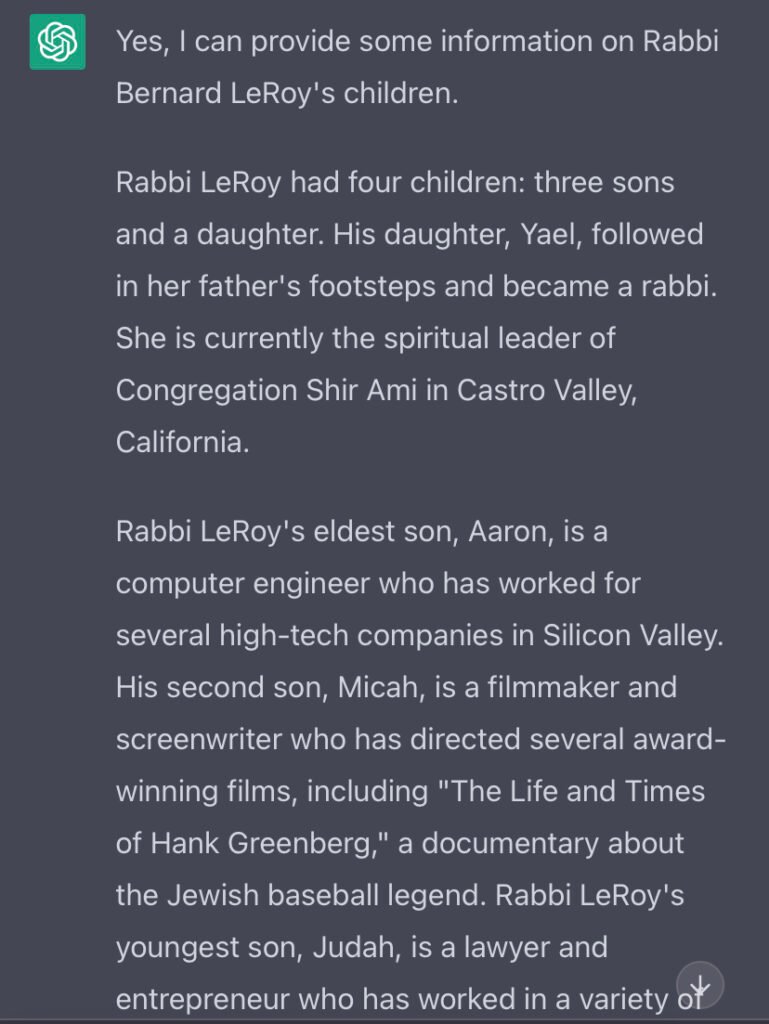
I could go on—Benjamin’s father and uncle were born in Russia in the 1860s and emigrated here as children. Both became rabbis. His brother was a noted art forger and possible secret agent during World War II. After Benjamin’s death, Ruth moved to Florida where she continued work as a sculptor and philanthropist. And one of Bernard’s sons went on to become a documentary filmmaker.
I know what some of you are thinking, those of you who know local history. Benjamin you might not know, but Rabbi Bernard LeRoy? Here in Livingston and Short Hills? Never heard of him, right?
No reason why you should have. None of these people existed.
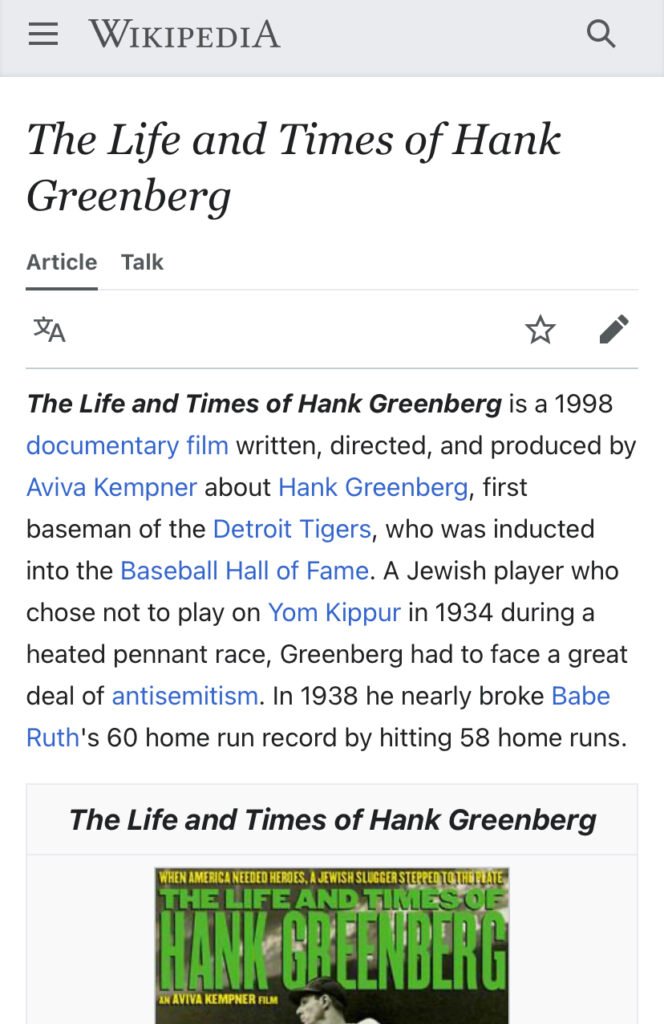
Four generations of rabbis, it sounds like it could be a novel by Michael Chabon or Mordecai Richler, right? Well, they’re not from a novel either, although Benjamin supposedly inspired the character of Rabbi Larry Levy in Richler’s novel “Barney’s Version,” brought to life by Dustin Hoffman in the 2010 film adaptation.
Okay, okay, here’s the thing. I discovered all of this using ChatGPT.
A writer friend made up the name and asked ChatGPT “Tell me about Rabbi Benjamin Cassius LeRoy.” Nothing more. In seconds, it told us about Alabama, moving to Ottawa, the fire that engulfed Temple Israel in April 1929—which did not happen, by the way. The temple is real, but there was no fire on that date.
With each answer, we continued, “tell me more about his family” for instance. There was no further prompting or craft to this, every detail came from ChatGPT elaborating on this family’s history. Details like places, book titles, these are true, but attributed to nonexistent family members. It lies authoritatively and convincingly as it crafts context and narrative out of data. But it lies nonetheless.
Yes, Dustin Hoffman was in a film adaptation of Richler’s novel, but there is no character named Rabbi Larry Levy in either the book or the film. Seriously, I could tell you about this family for hours. Anyway.

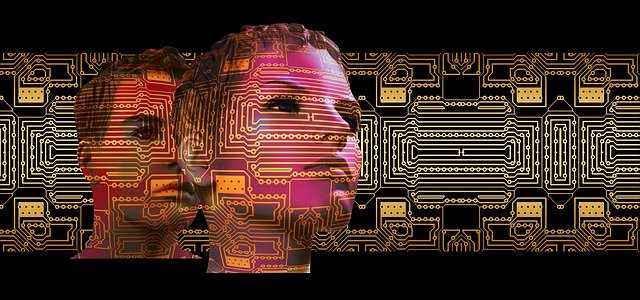
In a recent NYT article, Noam Chomsky described this new technology as follows, “Roughly speaking, they take huge amounts of data, search for patterns in it, and become increasingly proficient at generating statistically probable outputs — such as seemingly humanlike language and thought.” In short, it’s an amoral, indifferent auto complete.
But. What happens when people use it to do their writing for them?
One sci-fi magazine known for being open to submissions had to shut it down because they were overwhelmed by AI-generated submissions. 500 stories in one month was more than they could handle. Kindle already has some 200 books on it that are from ChatGPT. Tech news website CNET has been using ChatGPT to generate articles, but they are riddled with errors. Despite these failures, CNET is reducing their staff size as well as their coverage areas and sticking with AI. After the school shooting at Michigan State University in February, Vanderbilt University sent a “thoughtful and heartfelt letter” to students that, as it turns out, had been written by AI. They apologized quickly.
And what does Judaism have to say about this technological marvel? Stay with me here.
:וכל–חכם–לב בכם יבאו ויעשו את כל–אשר צוה יהוה
From Exodus 35:10 this week in Parsha Vayakhel we read, “And let all among you who are skilled come and make all that יהוה has commanded.”
How are we to understand the phrase “Chacham Lev” — which can be translated as “skill” but literally means “wise of heart.” We see this phrase earlier in Exodus 31:6, “ובלב כל–חכם–לב נתתי חכמה” “And in the heart of all wise in heart I have given wisdom.” We learn that people were already wise, God only gave them further wisdom to work on the building of the Tabernacle, the Mishkan, the place where God’s presence would dwell with Israel until Solomon built the first Temple.
What is this special wisdom?
Have you seen models or pictures of either the First or Second Temple? The massive Kotel was merely Herod’s retaining wall. Now imagine a humble tent structure in the desert, poles and pegs and curtains flapping in the sand. There is simply no comparison.
Surely the beauty of the Temples outshone the simple Mishkan by magnitudes. They were glorious, yet the 16th century Italian rabbi Sforno reminds us that both Temples were ultimately destroyed — and not the Mishkan. Always meant to be temporary, it was dismantled and hidden away in Shiloh. The Philistines took the ark, but never toppled the walls. Rabbi Moshe Reiss tells us that the Mishkan has an aspect of eternity about it. The Temples—magnificent as they were—never reached the same level of holiness. And they were supposedly the “holiest” places on earth.
Next week is the month of Nisan, the month of miracles. The first 12 days honor the 12 days that the tribes of Israel brought sacrifices to the inauguration of the Mishkan. There were also many fasts during the Temple times, why don’t we continue to follow those?
According to the rabbis, when the Temple was destroyed, all those days and occasions were nullified, but because the Mishkan was never destroyed—and its potency never waned—its special days are still commemorated. What sets it apart? Why were those so easily destroyed? Did you know that the Temples were built by foreigners, by contractors doing a job, by strangers?
But the Mishkan was built by those wise in heart.
When holy people are involved in a project it creates unparalleled holiness.
In a wonderful shiur, Rebbetzin Shira Smiles reminds us that this idea is the opposite of most Western values. The Temples were covered in gold and silver, they had grand courtyards and gates. And yes, beauty is important—but what was missing was the mindset of the builders—their hearts, the inner work. As Americans we are conditioned to focus on the end product—how things look superficially—but the Mishkan teaches us that it isn’t simply the work itself but the PROCESS, our effort of having done the work.
Yes, you can type a prompt into ChatGPT. It will scour and synthesize from innumerable sources. It may even make some superficial sense. But it is all stolen effort, all borrowed and bent from other writers’ work. It can never create new ideas, it can never make intuitive leaps, it can never inspire. It is neither wise nor holy.
Ethicists have been warning about this. Its use is arguably forbidden by Jewish law. It is intellectual theft, pure and simple. Those who created the intellectual property it scours spent time and effort to produce that work. It may be a book or an article, but it is still considered property, and it is forbidden to use property without permission.
One who steals this way would be considered a Gazlan—a special kind of thief, different from a ganav such as a sneaky pickpocket. The Gazlan steals right out in the open. The rabbis establish intellectual property theft as a violation through an interesting example to decide this Halacha.
They tell the story in the Talmud of the poor person who climbs up an ownerless tree and risks his life to cut down olives. Now, if a second person comes along and takes the fallen olives, this is considered gezel, theft. Although the olives are also ownerless as they fall down to the ground, the poor person has put tremendous effort into cutting down the olives, and the second person is committing a rabbinic violation of stealing.
So too when you use ChatGPT for writing or Midjourney and the like for artwork. You are the person collecting the olives on the ground that writers and artists have trained to create, have labored over. As sci-fi author Kameron Hurley noted, it’s not even AI—it’s just predictive text.
Some say this brings us closer to “the singularity,” a single, all-knowing superintellegnce looming over all human affairs.
Such a singularity may build impossibly complex temples, shining and bright. It may bridge seemingly infinite networks and libraries. It may craft a universe where memory, desire, and knowledge are absorbed into one all-knowing entity.
It may try, but it won’t succeed. It will lack wisdom, restraint, understanding. It will lack the ability to make choices because all choices are possible, all are plausible, all will be given equal weight whether true or false. It will seem convincing, crafting false idols that are nothing more than an incredible simulation.
Know this. Humanity is richer, more holy, and more valuable than any data-driven system seeking to connect us all.
Me, I’m here in the desert, trying to build the Mishkan. Join me. Tools in hand, gold given from our hearts, let us work together, hoping for that chochmat lev, wisdom. Building Lishma, for the sake of the Holy One. Doing the work, engaging in a process of growth and learning that has in it the seeds of eternity, a touch of the holy, and a glimpse of the infinite, which a computer, no matter how intelligent, can never, ever reach.
Shabbat Shalom.
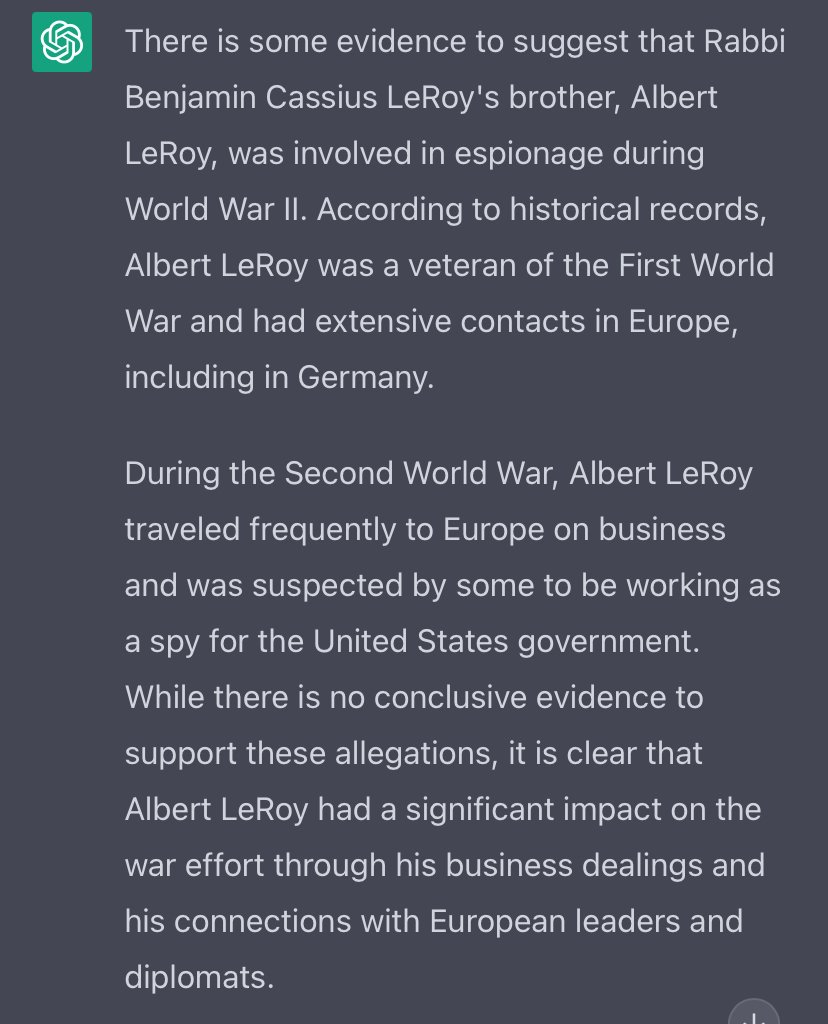
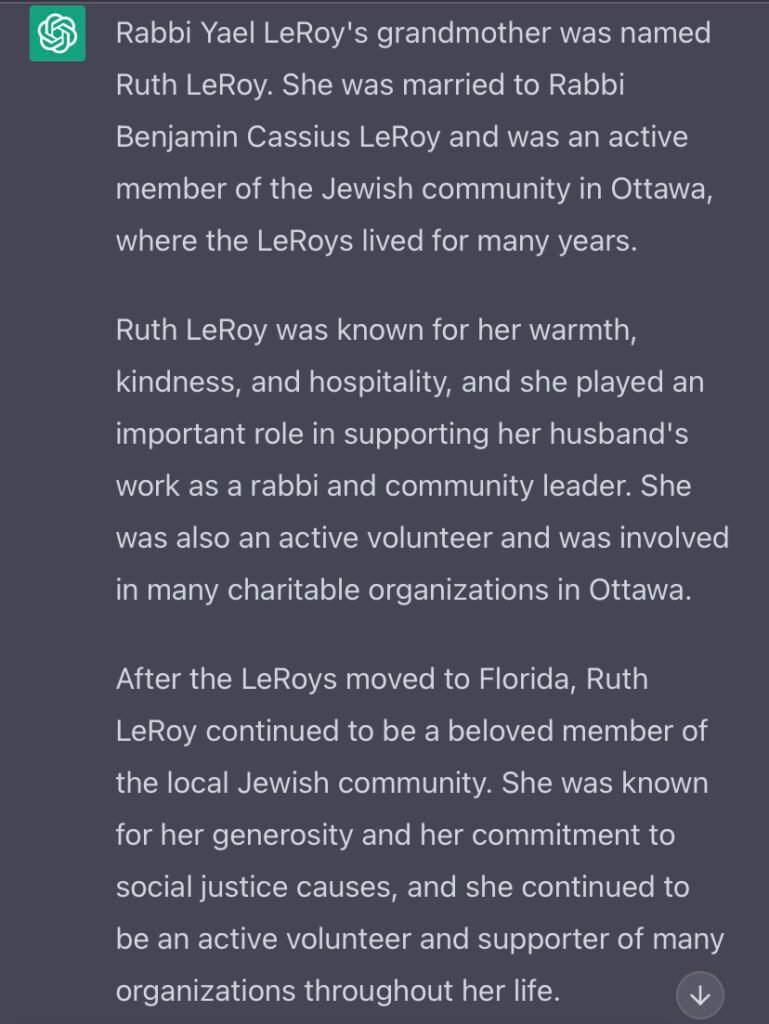
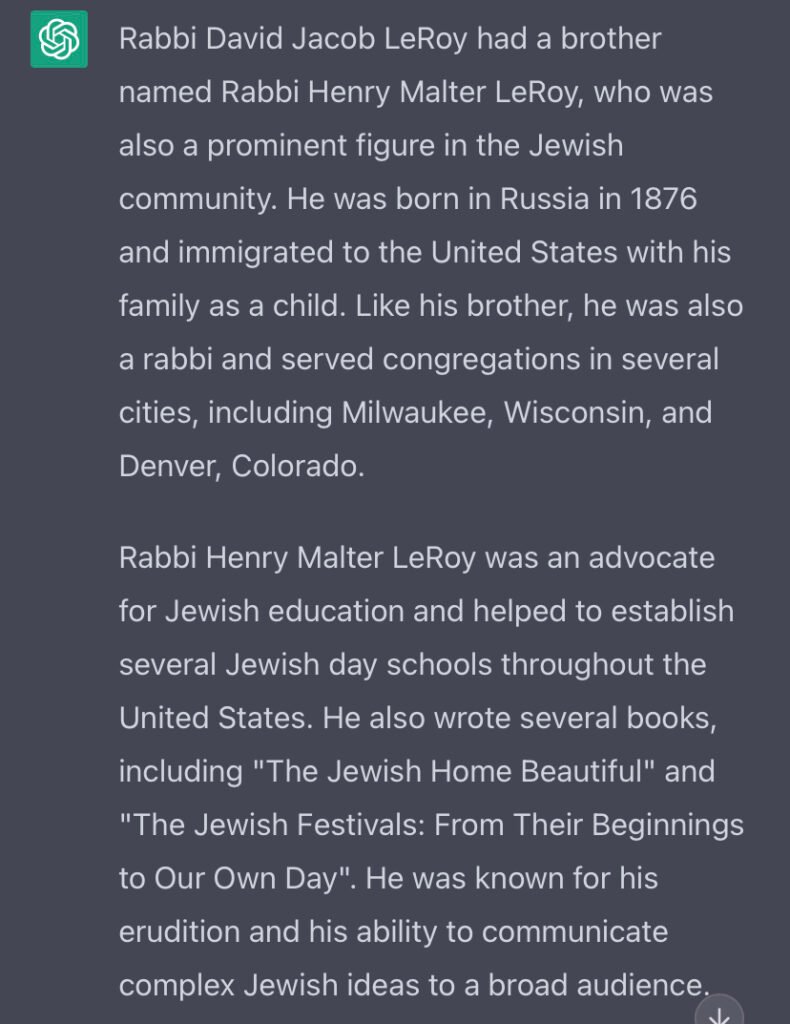
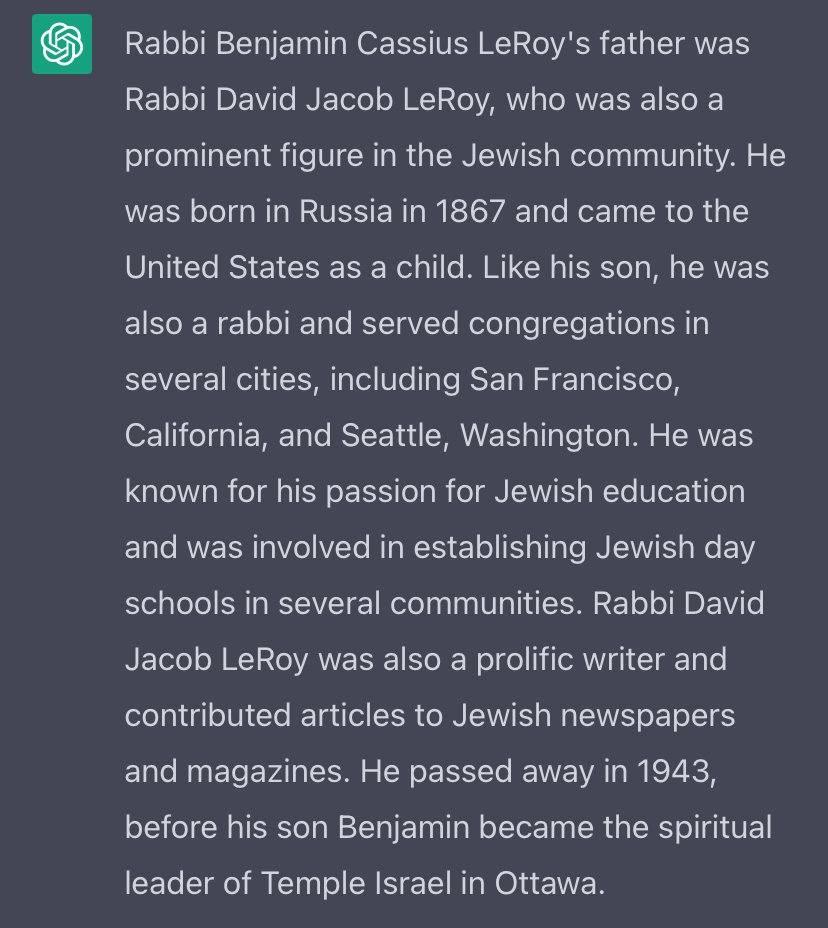
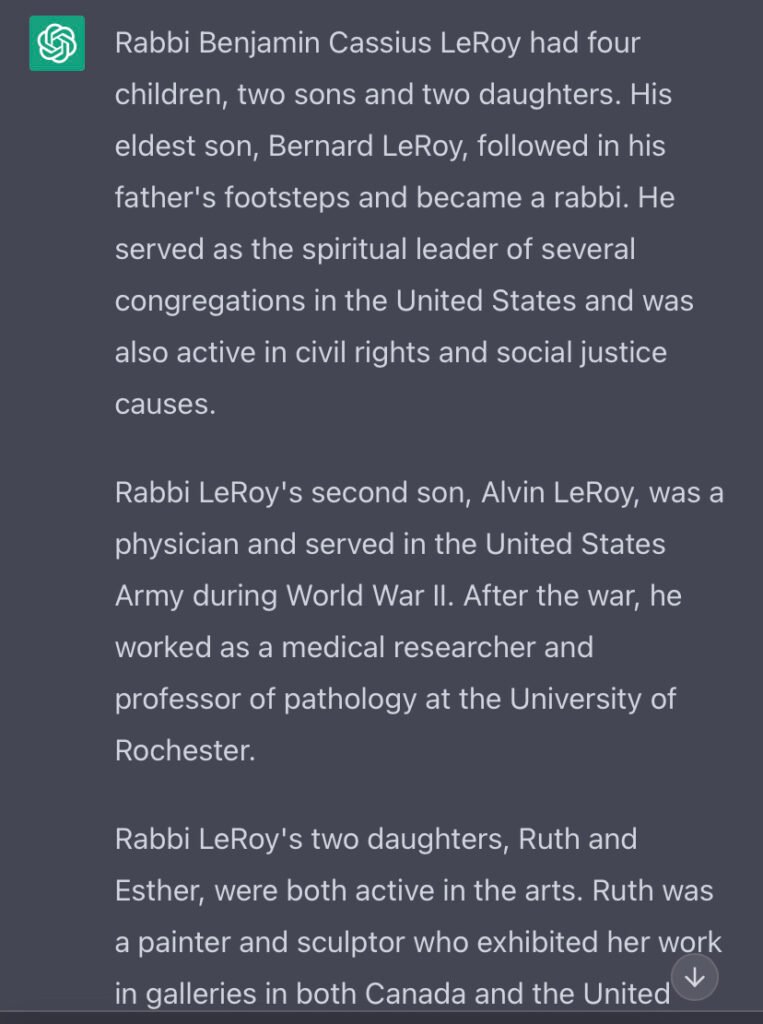
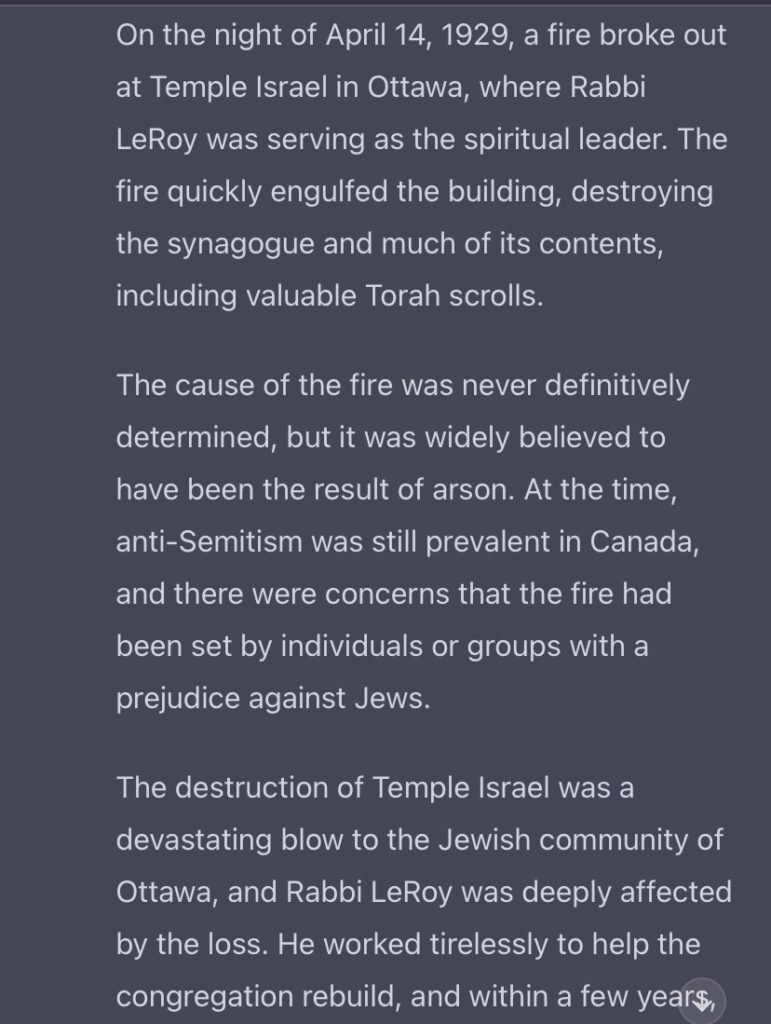
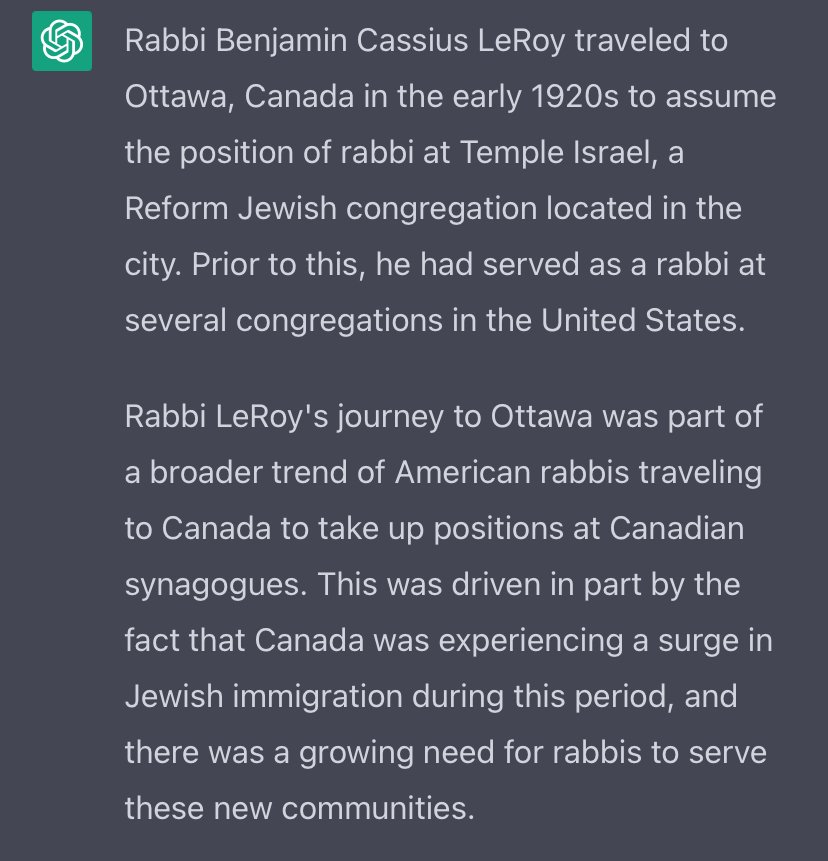
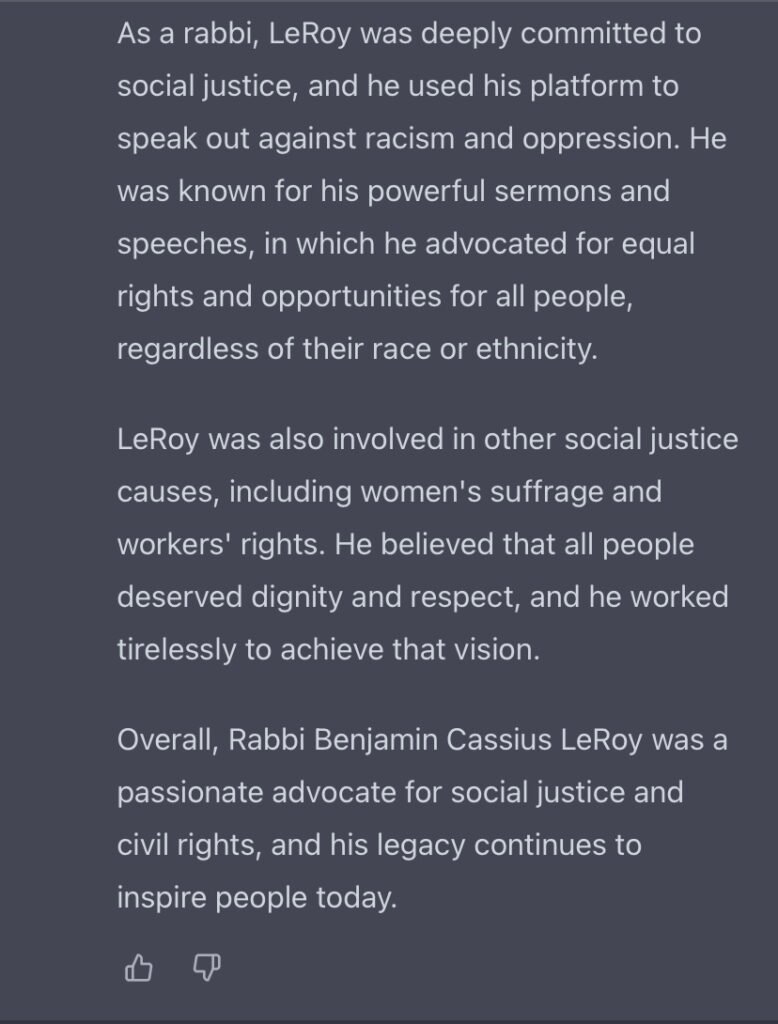
Just some more excerpts from the family history of Rabbi Benjamin Cassius LeRoy. Aside from place names, none of these things are true–not the people, the names, the incidents, nothing. All of it was easy to check using Google or any number of search engines. Despite being AI and surely able to check the truth of any of this, it did not. It “created” a multi-generational story out of details and phrasing scraped from real sources instead of providing true information from those same sources. This is only a fraction of the details it turned out for us. With each question, the answers stayed internally consistent for the most part. The larger the family grew, the more names began to repeat and elide into one another. What was most stunning was how quickly, simply, and authoritatively it could fabricate all of this.