
Be positive.
No, I’m not talking about the blood type, I’m talking about attitude. People will tell you to be positive, sometimes no matter what. Go into a Hobby Lobby and you’ll see pillows and wall hangings and signs to place around your house with things like…
“Gratitude creates happiness!”
“When you focus on the good, the good gets better!”
“Life is tough but so are you!”
“Beautiful things happen when you distance yourself from negativity.”
Maybe you’ve seen them online with the hashtag #positivityalways. And don’t get me wrong, I do like to be positive. I like to be happy, who doesn’t? Who wouldn’t want a beautiful, good, happy life? A house appointed like a model home? We all do. We all want the bad parts of life to disappear, fade into the ether, never to darken our doorsteps again.
In short, we want to be happy.
In her classic book, Bright-sided, the late author Barbara Ehrenreich noted that this fixation on happiness is uniquely American. Our stereotype is being relentlessly upbeat, cheerful, and optimistic to a fault while to us, foreigners can seem cynical and decadent.
But—and you knew there’d be a but—when studied by scientists, Americans are far from the happiest people on earth. The top countries are Finland, Denmark, and Sweden. Israel is number nine. The United States usually ranks around sixteenth or lower.
Did you know that two thirds of the world’s antidepressants are prescribed in the United States alone? Two thirds! Are we genuinely happy or has “the pursuit of happiness” at all costs become what Ehrenreich calls an “ideology?”
Here’s a question. Do you consider yourself an optimist or a pessimist? Is your glass half-full or half-empty? Or are you a realist who sees a glass twice as large as you needed? In truth, there is nothing inherently good or bad about any of these positions, they are simply choices, ways we each see and process the world.
Some will tell you “when life gives you lemons, make lemonade.” Why not lemon meringue? Or lemon garlic pasta? (Trust me on the pasta.) Why is it only ever lemonade? When it comes to happiness, hope, and optimism, one size does not fit all. What about lemon bars? I’ll stop, now I’m getting hungry…
Happiness, hope, and optimism are all positive conditions, and they can be great motivators. But they are not the same thing. Happiness is an emotion. But hope is often specific to a situation—it relies on an awareness of our own abilities as well as the conditions of the real world. It is grounded in reality. Optimism is more of a general condition, the idea that positive things will work out independently from our actions, abilities, or reality.
We are a people of hope. Hope for the best, prepare for the worst. That’s a good rule of thumb, and note, it allows for the real world, it allows for actions not in our control.
But optimism to the exclusion of all else…perhaps you’ve heard of “the power of positive thinking.” For example, if you “affirm” you will be wealthy, money will come to you. If you’re part of the River City Boys’ Band in “The Music Man,” just “think” that you can play an instrument and you can. It would be nice if it were that easy, right?
Barbara Ehrenreich was a breast cancer survivor. At one point in her treatment, she was told to visualize the death of bad cancer cells in her body to destroy them. That’s not how science works, and she knew that. Her experiences as a cancer patient confronted with this kind of thinking are part of what led her to write her book.
Note, the subtitle of the book is “How Positive Thinking is Undermining America.”
As Ehrenreich was well aware, bad things do happen, that’s just reality. If we are aware of them, if we know the risks, the possibilities, we can prepare for them and weather them. When we understand that reality is not always positive or perfect—that sometimes it simply cannot be either—we are still able to find hope even in the darkest moments.
There’s another book I’ve read recently: Toxic Positivity, by therapist Whitney Goodman. She notes that this type of positivity has become a goal and an obligation in and of itself. It is woven into our very lives. It’s in the schools and the workplace. It’s in our relationships. It’s in our craft stores and home decor. It’s even in our Peloton rides. A relentless, forced positivity that can turn us into emotional robots, turning it on and off. It’s a very hard habit to break for all of us, myself included.
What this type of positivity and the people who practice it don’t grasp is that reality can be tough, not everything will always be unicorns and rainbows. And when confronted with a difficult situation, a bad diagnosis, a hard road, sometimes these people can shut down. “I wasn’t positive enough. I didn’t believe in myself enough.” If you’re down or depressed, by this logic you’re not thinking positively enough, it’s your fault.
So where do we go from here? What do we do with our authentic suffering? How do we find hope then?
When I was in cantorial school at HUC, I took what’s called a CPE credit, Clinical Pastoral Education up at Columbia Presbyterian. I was only 23 and fresh out of school. There were nights when—knowing absolutely nothing about life—I had a beeper and was on call for most of the hospital as the chaplain.
Thrown into that situation, you learn a lot fast. I was in a cohort with men and women of all ages and backgrounds, and there was a wonderful head chaplain training us, a Presbyterian minister. And he brooked no nonsense.
One thing we learned—and this was paramount—was never to lie to patients. Never give false hope. Never tell a person waiting for a double amputation from diabetes that things were all going to work out. Stop with the empty platitudes. Be with the person where they were—the real actual person—and tell the truth.
I was assigned to an AIDS floor. At that time, protease inhibitors were just being developed. There was a woman on the floor that I got to know over several weeks. She was in bad shape. She was skeletal. Bones protruded and her body had sores. She wasn’t going to live much longer. One day we got to talking and she turned to me—and I will never forget this—and she said, “You know what, I took the drugs, I knew the risks, I did this to myself. I did this to myself.”
In that moment, facing the real world, facing her honesty, I struggled with 23 years of being programmed to be “positive.” The automatic and easy answer was to say, “No, no, no. This is not your fault at all. Stop that.” But saying those words would dismiss her hard won knowledge, her journey, her process towards reconciling her reality. I hesitated for a few heartbeats. And then I took her hand and I just said, “Yes, yes you did.” We sat in silence, being with one another, facing our realities together. Those were some of the hardest words I have ever said.
With toxic positivity, there is no space for suffering. There is no empathy, no understanding, and no space to process. We are told, “this uncomfortable emotion should not exist” and so it should not. Healthy connections leave room for reality, they allow us to face and deal with reality, but toxic positivity shuts people down.
Here’s another one I saw under that #positivityalways tag. “I am only interested in hearing your problems once. Our next conversation has to be about solutions.” Sometimes, you need more space to process those problems or even to understand them. Sometimes, the solution is acceptance. There’s a reason that’s the last in the five stages of grief.
So what does Judaism say about suffering? Do we embrace it as enobling? Do we as Jews believe the saying, “Time heals all wounds?” I’m here to tell you no, time does not heal all wounds. As Jews we’re still crying over a temple destroyed 2000 years ago!
How about “This is all part of God’s plan!” NO it is not part of God’s plan to give you a disability or take a loved one too soon. God hasn’t mapped out who will have a car accident where and when. Bad things do happen, but that’s a sermon for another day.
The Talmud is often inscrutable but tucked away between the legalese are amazing stories, called Uvdahs. The story I want to share teaches us one way of approaching suffering and trouble. We do not need to welcome it or look on the bright side—we do not need to ignore it, we need to see it for what it is.
Rabbi Yoḥanan’s student, Rabbi Ḥiyya bar Abba, fell ill.
Rabbi Yoḥanan entered to visit him and said: Is suffering something you like?
Rabbi Ḥiyya said to him: neither it nor its reward.
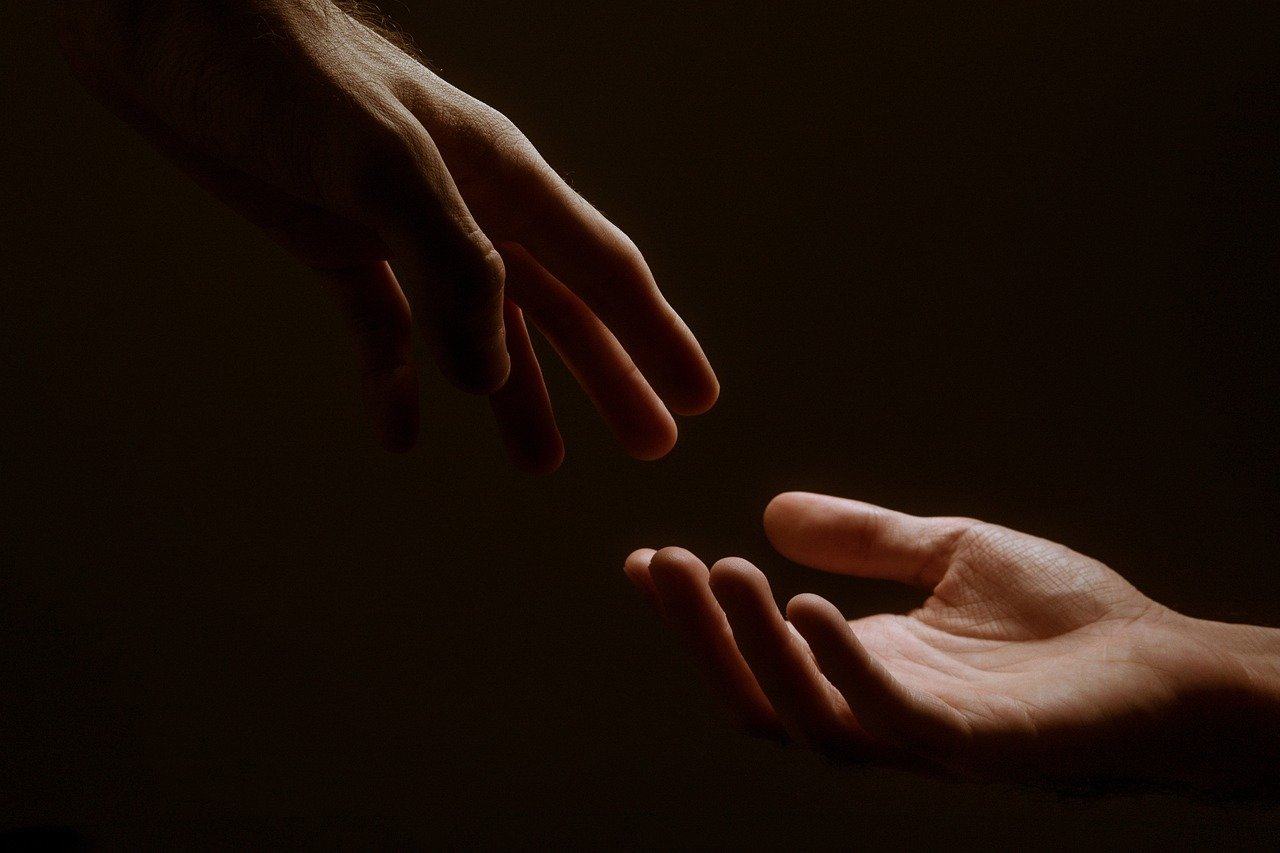
Rabbi Yoḥanan said to him: Give me your hand.
Rabbi Ḥiyya bar Abba gave him his hand, and Rabbi Yoḥanan stood him up.
Then Rabbi Yoḥanan fell ill. Rabbi Ḥanina entered to visit him and said: Is suffering something you like?
Rabbi Yoḥanan said to him: neither it nor its reward.
Rabbi Ḥanina said to him: Give me your hand. He gave him his hand, and Rabbi Ḥanina stood him up.
The greatest rabbis of all time, the sages upon whom Judaism itself stands REJECT any benefit or rewards to be found in their suffering. There is no bright side! They are not sharing platitudes like “what doesn’t kill you only makes you stronger.” They are not assuring one another that “others have faced worse.” Or “at least it’s not cancer.” The sick person, the person in distress, does not want the supposed “reward” of suffering.
A simple hand is extended, a hand of help and friendship. No words are spoken, but each is able to raise the other out of bed through the power of PRESENCE. The power of empathy. The power of facing reality together.
Be with someone where they are and you WILL lift them up. Offer a hand, reach out, and you can indeed pull a friend or family member up.
Judaism embraces every emotion and every human experience. We are a people of loss and trouble. We are a people who don’t paper over problems. We are a people who have fast days and days of mourning throughout the year. We are a people who go the Kotel to cry. We know the power of tears and we let them flow. A Yiddish proverb, “Vi zeyf farn guf, azoy zaynen trern for der neshome.” Like soap for the body so are tears for the soul.
Without the ability to grieve, to cry, to understand, we cannot grow or heal, we cannot be whole.
Be happy, hopeful, and optimistic, but be patient when we’re not, when we cannot.
Be aware of reality, be prepared for whatever comes, and be ready to face the real world with strength, support, and a hand to hold in the darkest of times. And the lightest of times as well.
Reach out a hand when you need to be lifted, and lift someone up when they reach out to you.
And be positive when you want to be positive.
Shana Tovah