
On this night of nights, this eve, I want to talk with you about a powerful story, one that has many followers, many believers even. And it all began a long time ago with a star in a place far, far away.
Of course, I’m talking about Star Wars.
Tonight, I want to tell you about the Reylo fans.
Reylo is the shorthand for the relationship between Daisy Ridley’s noble, connection-seeking heroine, Rey, and Adam Driver’s volatile, power-hungry villain, Kylo Ren in the recent Star Wars trilogy. More than a villain though, Kylo Ran was once Ben Solo. They are what the films call a “Force dyad.” The two are connected in a profound way, they are drawn to one another and cannot explain why at first. They speak across light years with a force bond never before seen. And in some sense, the question for Rey is, is she bonded with Kylo Ren or with Ben Solo?
I know, you’re wondering where I’m going here. But there is one scene in The Last Jedi that connects intimately with our parsha this week. Trust me.
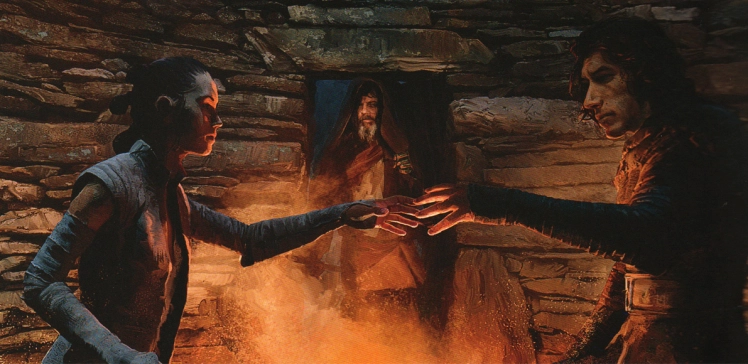
Rey is on an island on the planet Aach-to with Luke Skywalker, trying to get him to return to the fight or, at the very least, to help train her in the ways of the Jedi. As part of her training, she enters a cave looking for answers to her lineage and history. She is narrating as is talking with someone, we’re meant to assume this is Luke.
The camera cuts to her as she rests by a fire, and across from her—though he is lightyears away—is Kylo Ren, unmasked. The fire between them is intimate, the connection strong already. Each tells the other they are not alone. And slowly, Rey extends her hand. Kylo hesitates, then slowly takes off his glove to reach out to her and meet her across time and space. But has he removed a glove or all of his masks? Is this Kylo or Ben? Their bare hands touch and…
This week, in Parshat Shemot, the greatest prophet who ever lived does the same thing.
Exodus 3: 1 Now Moses, tending the flock of his father-in-law Jethro, the priest of Midian, drove the flock into the wilderness, and came to Horeb, the mountain of God. 2 An angel of the LORD appeared to him in a blazing fire out of a bush. He gazed, and there was a bush all aflame, yet the bush was not consumed. 3 Moses said, “I must turn aside to look at this marvelous sight; why doesn’t the bush burn up?” 4 When the LORD saw that he had turned aside to look, God called to him out of the bush: “Moses! Moses!” He answered, “Here I am.” 5 And He said, “Do not come closer. Remove your sandals from your feet, for the place on which you stand is holy ground. 6 I am,” He said, “the God of your father, the God of Abraham, the God of Isaac, and the God of Jacob.” And Moses hid his face, for he was afraid to look at God.
“Remove your sandals from your feet, for the place on which you stand is Holy Ground,” We cannot connect, we cannot be present, we cannot stand in holiness when we are covered, when we are shod, when we hide from the truth. We must be naked. We must remove our masks whether literal or metaphorical. We must be open to trust.
Rabbi Shomo Ephraim of Luntchitz, a 16th century rabbi, wrote in his commentary, Olelot Ephraim, “The world is always full of sharp objects and stones. When one wears shoes, he can easily step on the small stones lying on the way, almost without feeling them. However, when one walks barefoot, he feels every small thing lying on the ground, every thorn, every painful stone. God said to Moses, the leader of Israel, “Take off your shoes.” The leader of the generation must feel every obstacle and every impediment on the road. He must feel the pain of his people and realize what is bothering them.”
For Rabbi Ephraim, when we are safe in our shoes, we are unable to feel the challenges, the pains, the hard path. In order for Moses to be worthy of leadership, to approach the Holy, he had to strip himself of the protections against discomfort. He had to understand not just the pleasant and the comforting but the unpleasant as well. Without that awareness—without feeling and hearing and seeing that which countered and challenged his assumptions, without being able to adapt to that which did not fit his assumptions, how could he be an effective leader for his people?
Life is challenging. Days are long. But only through removal of the safe outer shell, can we approach the holy and stand in God’s presence.
What is to be learned by the thornbush, the lowliest of trees. In Exodus Rabbah we read a midrash about this exact question: A heathen asked R. Joshua ben Korhah: Why did the Holy One see fit to speak to Moses out of a thornbush and not out of another kind of tree? He replied: Had he spoken to Moses out of a carob tree or out of a sycamore tree, you would have asked me the same question; but to dismiss you with no reply is not right. So I will tell you why. To teach you that no place on earth, not even a thornbush, is devoid of the Presence.
In a similar vein, the Chofetz Chaim teaches that we shouldn’t say we will wait for a time when we are rich and at peace to start studying Torah and doing the commandments. People complain to him that they have no time for Torah and mitzvot, to which he replies, “How do you know that is better to serve God when one is wealthy? Maybe in Heaven they do not want you to be wealthy, but want you to serve God in poverty, with your limited time and money. “The place where you stand,” your situation and your problems, “is holy ground.” It is God’s will that you serve Him in your distress and poverty.
Where you stand NOW today is holy ground if you are aware of it. Don’t wait to win the lottery to start learning and doing right — start now in the place where you are!
And finally, our third lesson, very simple and yet very hard to manifest. How long do you have to look at a bush to see that it is burning but not being destroyed? A minute? Five minutes? 10 Minutes? Remember our text — ONLY WHEN MOSES TURNS AND LOOKS does God call out to him. God wanted to see if Moses was a man who was distractible, only looking at the surface, checked out. It is only when Moses takes the path to see this miracle—only when he is open to God’s grace—can he enter into conversation with the transcendent. How many burning bushes do pass every single day. What are we missing? What are we blind to? How can we open our eyes? As Nachum Sarna says, “To see that a bush is on fire is easy; to see that it is not consumed takes time and patience.”
I’m not going to spoil the rest of the Star Wars story, but I will say this. Being a Reylo is about hope. Being a Reylo is seeing that no one is beyond redemption. The Star Wars stories are, at their heart, about redemption. It isn’t too late for Darth Vader, and the cyclical nature of the films means it’s probably not too late for Ben Solo either. Very few Reylos want Rey bonded with Kylo Ren—we’re all hoping for Ben Solo. In being open to trust, to seeing, to listening, even the villains of the galaxy can turn, they can change, they can be redeemed. No one is alone, no one is trapped, we just have to find our way.
The light side is always there, the dark need not consume us. There can always be a hand extended through the fire to help us turn towards the light. Shabbat shalom.