
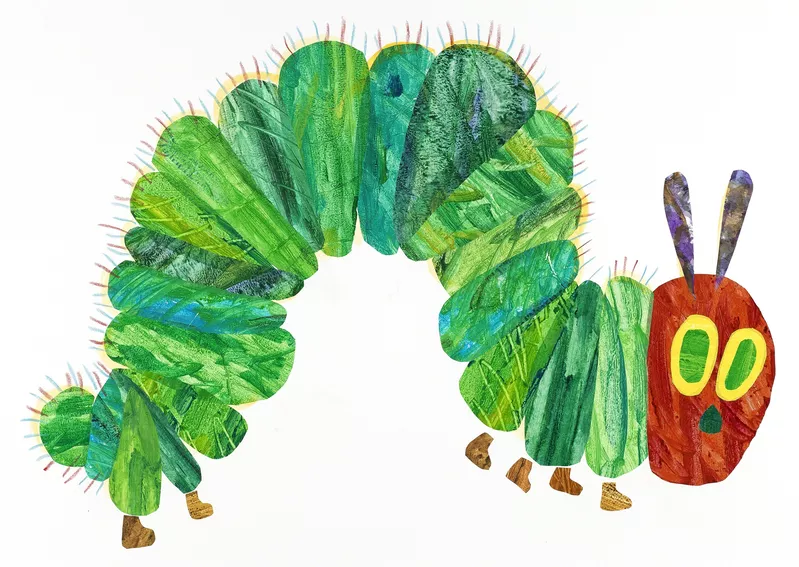
A few weeks ago, we lost Eric Carle. Unless you have children—or have had them within the last fifty years—you might not know his name. But you may know his most famous book, The Very Hungry Caterpillar.
In two hundred and twenty-four words, he told a timeless story about birth, life, growth, faith, and always moving forward. I don’t know how many times I’ve read this to my girls, but after a few times, you get the rhythms down, you remember it by heart.
In the light of the moon, a little egg lay on a leaf.
One Sunday morning, the warm sun came up and pop! – out of the egg came a tiny and very hungry caterpillar.
Over the course of a week, the caterpillar eats more and more things each day.
On Monday he ate through one apple. But he was still hungry.
On one level, it’s a counting book, teaching numbers, days of the week, even good fruits and vegetables. But on deeper level, it’s about trusting—and hoping—that there will be enough food tomorrow. One apple, two pears, three plums, and so on.
Until Saturday.
On Saturday he ate through one piece of chocolate cake, one ice-cream cone, one pickle, one slice of Swiss cheese, one slice of salami, one lollipop, one piece of cherry pie, one sausage, one cupcake, and one slice of watermelon. That night he had a stomachache!
This week, we find ourselves at a critical juncture in the story of the Israelites.
After a year at Sinai, they are finally on the march, with a cloud by day and a pillar of fire by night to guide them. The people were already showing doubts and fears, immediately they complained about the lack of meat and had to be satisfied with Manna. Even Moses kvetched to the Lord about his burden. Things eased, but still they complained.
“Why did we ever leave Egypt?”
Now, in Shelach Lecha, we stand at the brink of the beautiful, the promised, the sacred land of Abraham, Isaac and Jacob. We made it. We’re here. We are on the verge of entering. We have hungered for so long. It’s so close we can almost taste it.
Moses selects and sends forth 12 scouts to enter the Land. These men were leaders of their tribes, young and hearty, seemingly ready for the challenge. What kind of country was this? Are the people many or few? Strong or weak? Is the Land good? Are there fortified cities?
We know what happened, don’t we? Except for Caleb and Joshua, these scouts came back with negative reports. The place is PACKED with strong men, strong cities, we can’t possibly take them on. It’s impossible. Of course, this threw the camp into an uproar.
They had no heart, no hope. They had no faith in the Transcendent Power of God which lived with them in the cloud and traveled with them in the Ark.
Even Indiana Jones understood the power of the Ark…
In practice they were a faithful community with God at the center, but when push came to shove, in reality this group of former slaves had no sense of the Transcendent with them — no FAITH and NO HOPE.
They cried and wailed. They ignored the words of Caleb and Joshua. They demanded, “It would be better for us to be back in Egypt! — Let us go back to Egypt.”
They experienced an theophany like no people have ever had on earth. They stood and received Torah. But now because of a few walls and a few words, they would rather throw that all away and go back to where they once belonged, or felt as though they had. Back to slavery. Back to servitude. They left Egypt but Egypt did not leave THEM.
God was enraged, “How long will this people spurn me, and how long will they have no faith in me despite all the signs that I have performed in their midst.” He’s ready to kill them all. Start fresh with a new Nation from Moses — make Moses a new Abraham. He’s 100 percent DONE with the Israelites. And who could blame him? But Moses saves them from death…again. But their punishment is not light.
These fearful men and women with the slave mentality, everyone over twenty years of age will NEVER enter the Land of Promise. They will lie in unmarked graves in a harsh desert, bones worn away by sun and sand. They shall never reach the milk and honey, never see the fruitful land. Only their children, a generation forged in the desert, born in freedom will cross the Jordan—of these early leaders, only Caleb and Joshua enter the promised land—and it is this generation that will establish the tribes there.
How do we leave Egypt? I don’t mean the place. Here, Egypt is a mindset. An existence of want, fear, and self-doubt. It sees giants ready to crush, cities too large to take. When you are living here, everything seems insurmountable. Impossible. You want to go back to what you know, even if that place is one of constraint. Abuse. Fear. Because it’s what you know. It’s where you learned to survive.
How many people stay in relationships for fear of being alone? Or bad employment situations for fear of never finding better? How many stay frozen, never achieving their dreams because they see only giants and fortifications arrayed against them?
It is BITACHON which can move us forward. The word is based on the root – Batach which means “to lean on” — and it is a unique kind of faith — faith in an active sense, consciously placing the burden—one’s concerns and worries—on God and trusting that things will work out.
“According to Rabbi Benzion Shafier, Emunah is a state of understanding; bitachon is a state of trust. Emunah means knowing that HASHEM is involved in every activity on the planet; bitachon means trusting in HASHEM in every situation. Bitachon is predicated upon knowing that HASHEM has my best interests in mind and that He knows better than I what is for my good. When a person realizes this, and then takes his heavy load and transfers it to HASHEM – that is bitachon.”
You may be wondering what happened to the caterpillar. After that Saturday, he was no longer hungry, but he did not feel well. On Sunday, he ate through one nice green leaf and he felt much better. He built a cocoon around himself—he made his home—and after a time, he pushed his way out as a beautiful butterfly.
The story was inspired by Carle’s childhood. He was born here to German immigrants in 1929, but his mother was painfully homesick, so when he was six years old, she took the family back to Germany. She wanted nothing more than to go back to what she had known, and her husband obliged her.
Needless to say, this was a terrible idea. Carle’s father was forced into the army and quickly became a prisoner of war in Russia for the duration of World War II. In the meantime, Carle and his mother had struggled to stay alive themselves, never knowing if there would be enough food tomorrow, the next day, the next week. Or even if there would be a home. Being a child, he managed to avoid military service, but was conscripted to dig trenches along the 400 miles of the Siegfried Line. When they were reunited after the war—a minor miracle, considering—his father weighed 85 pounds and was, as Carle recalled, “a broken man.”
When he could, Carle came back to America with a college degree in art and $40 to his name. But he had faith in his abilities and trust that he would find a better life—he was moving forward. He got a job with the New York Times and eventually quit to become a freelance artist and then, of course, a children’s book author and illustrator.
On the fiftieth anniversary of the Very Hungry Caterpillar, Carle talked about how his wartime experiences had influenced the story. And he was asked why he thought this book out of all of his work was so popular.
“It took me a long time, but I think it is a book of hope,” he said. “Children need hope. You—little insignificant caterpillar—can grow up into a beautiful butterfly and fly into the world with your talent.”
May we all remember to be butterflies, always moving forward one meal at a time.